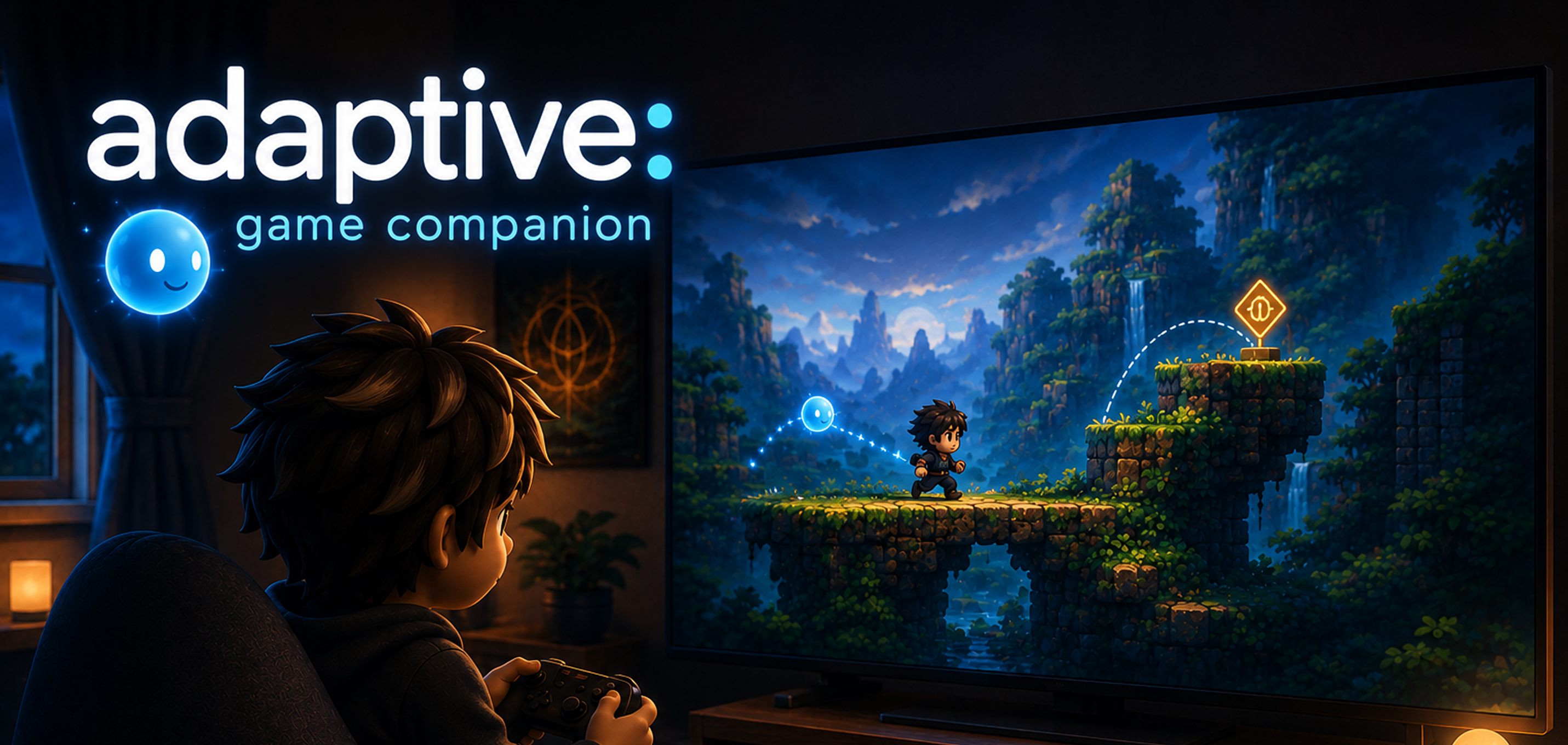
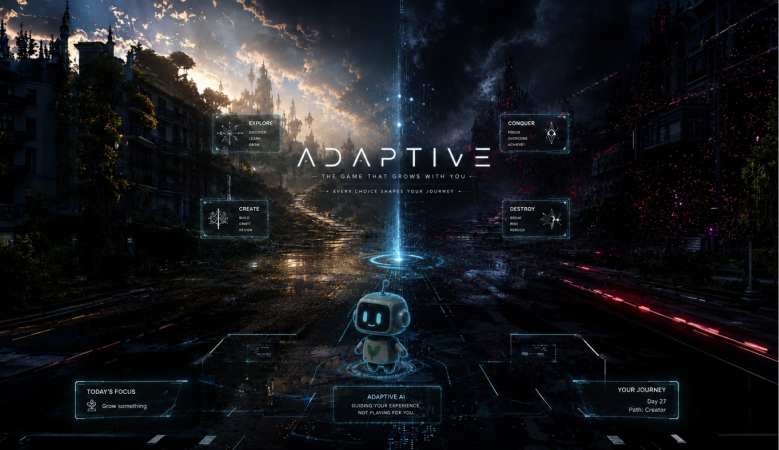
A digital companion support system that helps players grow their skillsets without fear of judgement — through analysis and observation, it gives tailored quests and guidance that rewards the player for creativity and skillset growth.
Gather
Before any research moved forward, the partnership was defined. Six levers determined how Claude would operate — not as a generator, but as a focused collaborator staying close to the sources and pushing back on generalizations.
A thinking partner, reviewing ideas and noting which parts might be successful or unsuccessful for the project scope.
Bring alternative options that are relevant to consider so all options can be explored before committing to a direction.
Push back on generalizations and jumps to conclusions. Explore all possibilities in the process — not just the end result.
Be thorough and don't leave information out. Responses in list format — no long paragraphs. Thoroughness over elegance.
Remain factual. Give exact responses, no opinionated statements, no assumptions or immediate conclusions.
Keep returning to sources and project layout first before bringing in outside information.
Your prompt
"Consider this information — Some video gamers face dissonance between their skill level and the games available to them. The AI works in the background, generating a place on a scale for the player to exist. A person who has played games across all genres, has experience, is genuinely interested, but underwhelmed by what the market offers because nothing addresses their demographic."
Claude
"Noted. What this project has to be: screen-based or digital in its final form / experiential through interaction, not through presence in a space / reproducible — it can't be a one-of-a-kind artifact / communicable without the designer being in the room. What these three exclusions do not resolve: whether the deliverable is a playable prototype, a concept system, a design specification, or something else entirely. Your tagline describes a technically complex AI system. Not an object, not an environment, not an exhibition gets you to a screen — but it doesn't tell you how much of that system you are expected to actually build versus design and represent."
What it changed
This was the turning point where I moved away from a game system and thought about creating something that can expand across many audiences. The question of fidelity was the one I had been avoiding.
What was the question underneath the question? What made this worth a full quarter?
Feeling frustrated, lost, and confused when entering a new gaming genre that you've never tried before.
Failing in video games and experiencing a difference in skill level between yourself and other players online.
In gaming communities, divergent gamers cannot have equitable gaming experiences because game designs don't account for all individuals of different levels and backgrounds, resulting in frustration, self-esteem and sense of belonging/identity dissonance, confusion, and internal/external pressure.
Explore
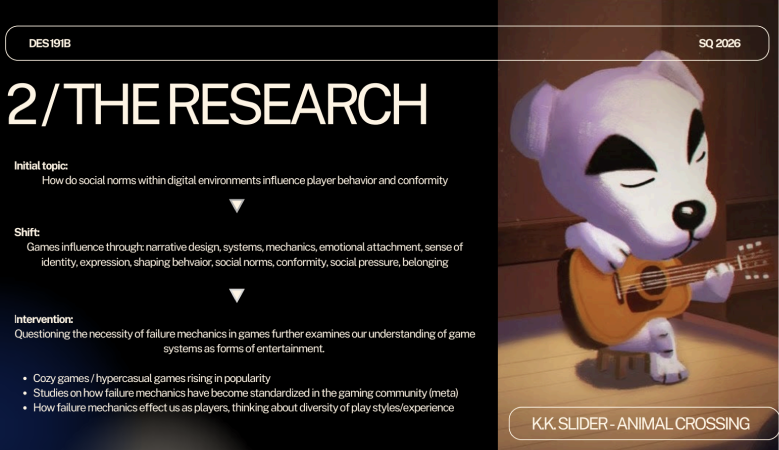
Three sources shaped the direction. AI research intervention moved the project further away from AI vs. the self and more toward video games as the central environment where this internal/external experience occurs.
Research
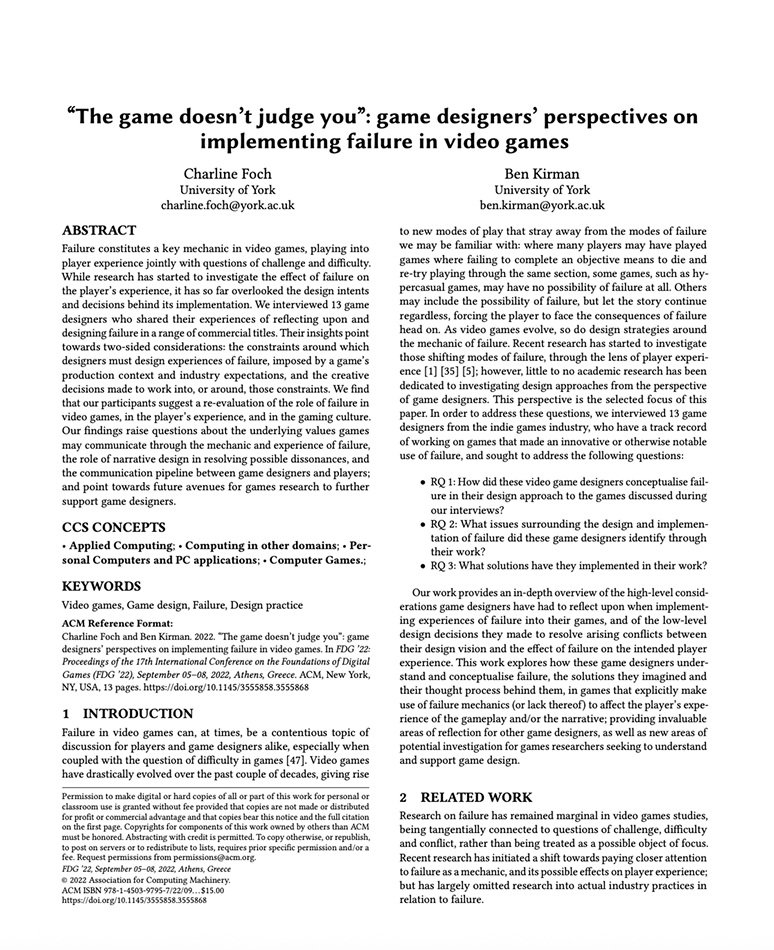
This Game Doesn't Judge You
How game design choices communicate acceptance or rejection to the player — and what it means when a game withholds judgment from someone expecting to fail.
Research
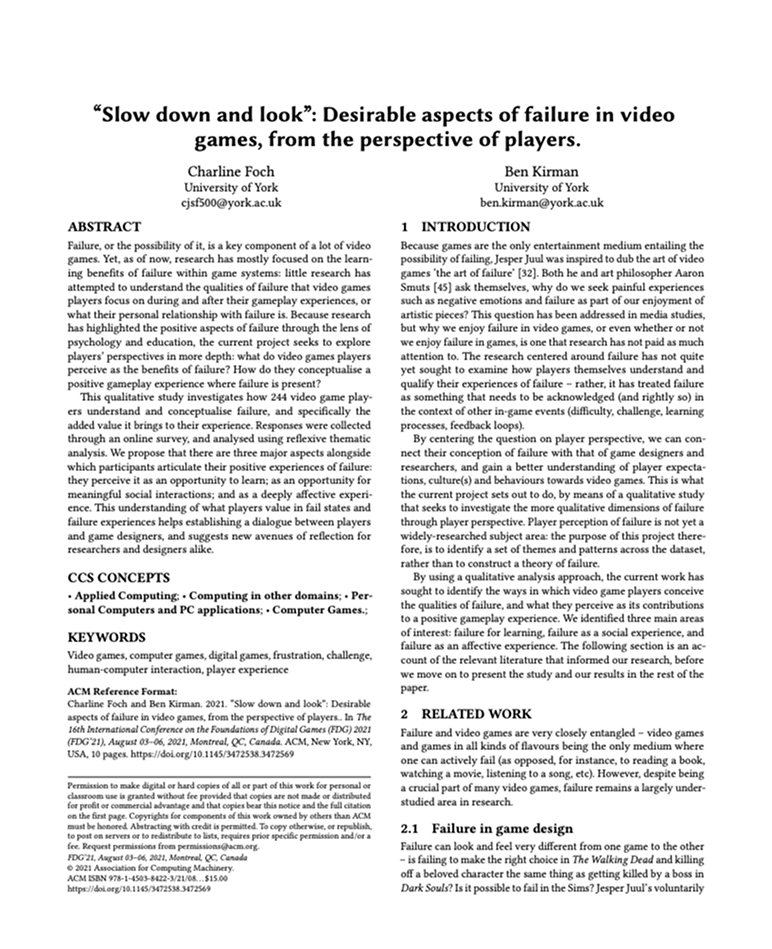
Desirable Aspects of Failure in Video Games
Why failure mechanics can be motivating rather than discouraging — and the narrow conditions under which a player accepts failure as part of the experience rather than a verdict on their worth.
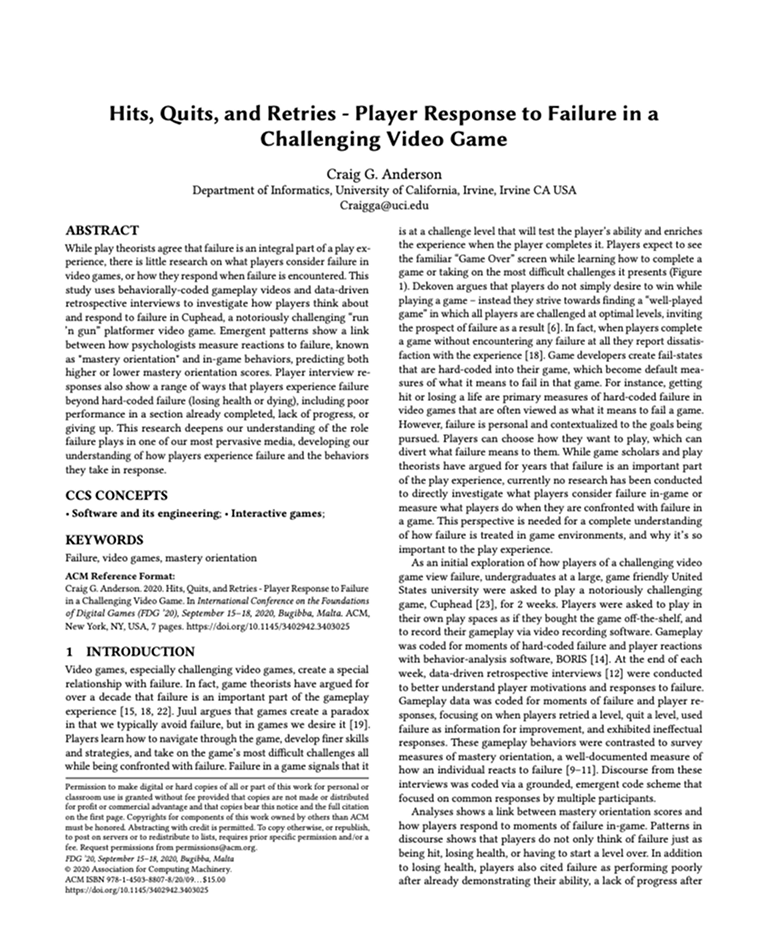
Research
Player Response to Failure in Video Games
The emotional arc players move through when they fail — frustration, resignation, quitting — and what design interventions interrupt that arc before it terminates the session.
The combination of research and AI intervention brought the project further away from failure vs. the self and more toward video games being the central environment where this internal/external experience occurs.
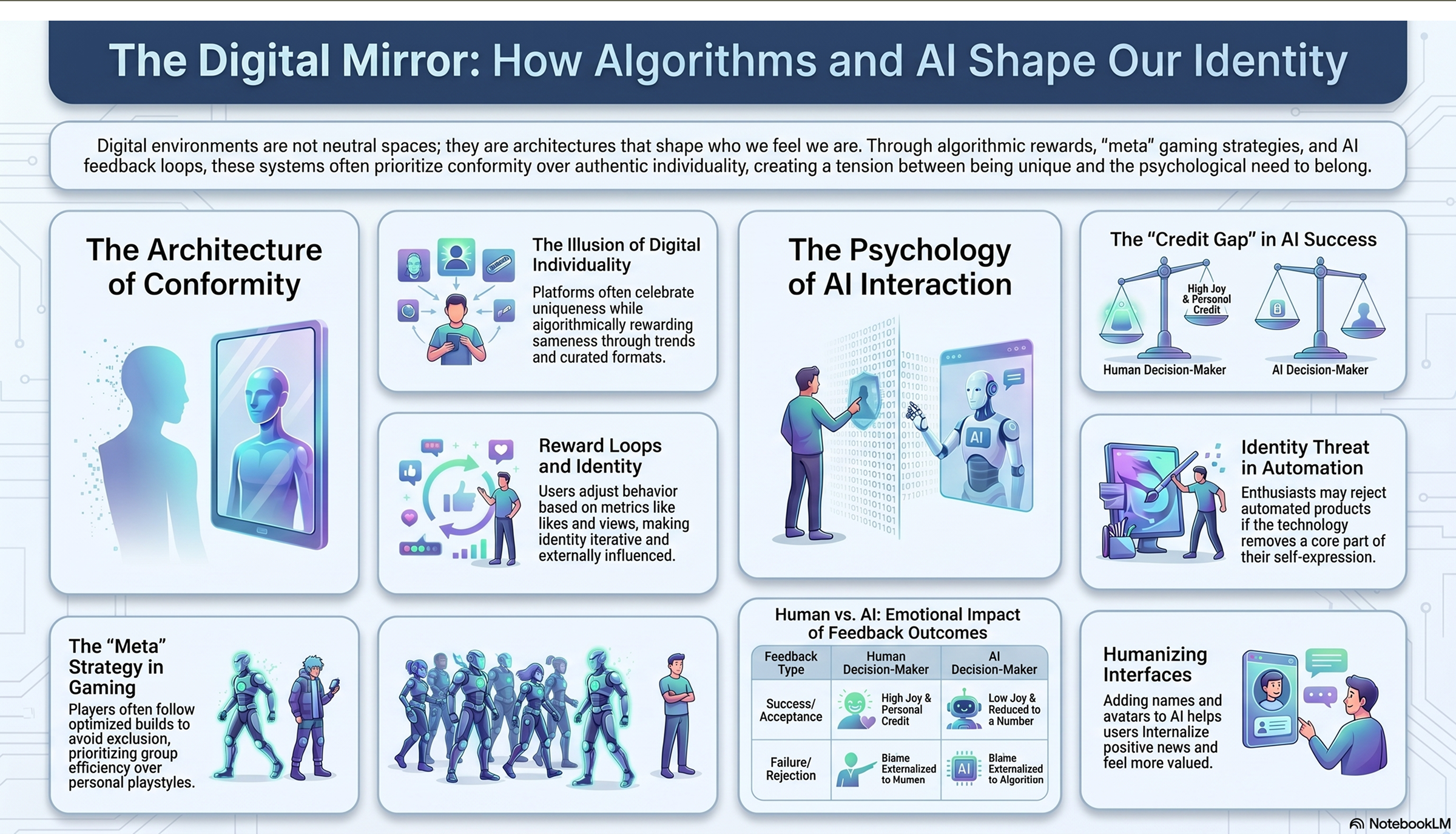
What it revealed
The combination of research and AI intervention brought my project further away from AI vs. the self and more towards video games being the central environment this internal/external experience occurs in.
Narrow
There is an opportunity to shift divergent gamers from dissonance to fulfillment during their gaming experience by addressing underlying biases in game designs.
How can differing game design systems aid divergent gamers in digital environments?
How do games utilize digital environments to create senses of belonging, identity, or dissonance for gamers?
How can we design new systems for games that create equitable experiences for all gamers?
Your prompt — going back to the person
"Let's go back to the person. What issue might they be going through that would make them want to try this game? How would this game solve their problem?"
Claude
"Every game they have ever played eventually stopped responding to them. The world became familiar, the systems became legible, the experience shifted from something they were inside of to something they were executing. When that happens, they leave. Not dramatically — they just quietly stop opening it. The result over time is a specific kind of frustration that is hard to name. It is not anger. It is closer to resignation. The question they carry is not 'what game should I try next' but 'is there actually a game out there that was made for how I experience things.' Every other game was made for a general player. This game is made for them specifically."
What it opened
I had a product, but couldn't find the connection between my design and the person I was envisioning. This intervention helped me realize what issue exists that my design was solving.
The presentation revealed that I still had only a demographic, not a person. I still needed to narrow down my focus on who I was designing for, and what specific problem I was trying to solve.
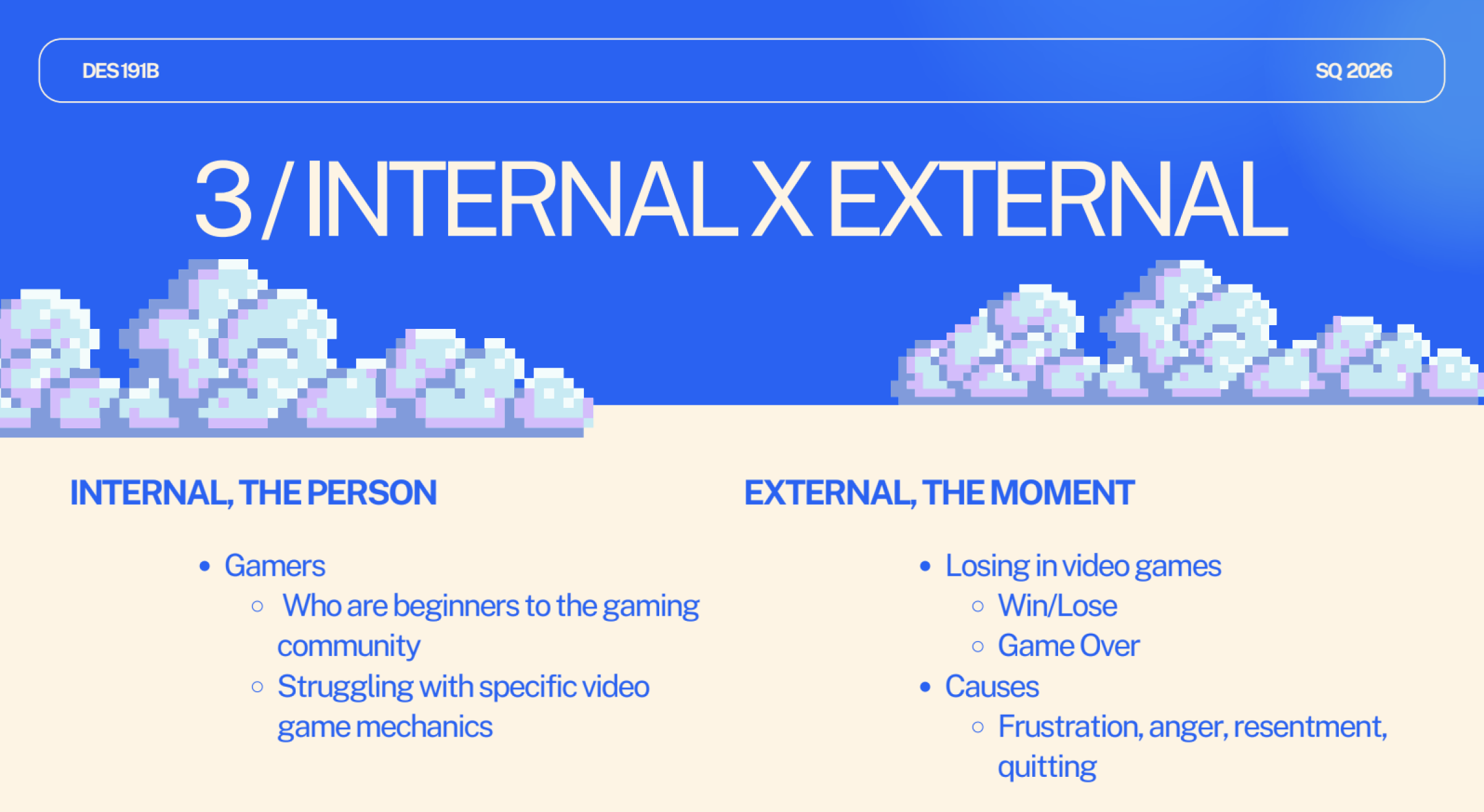
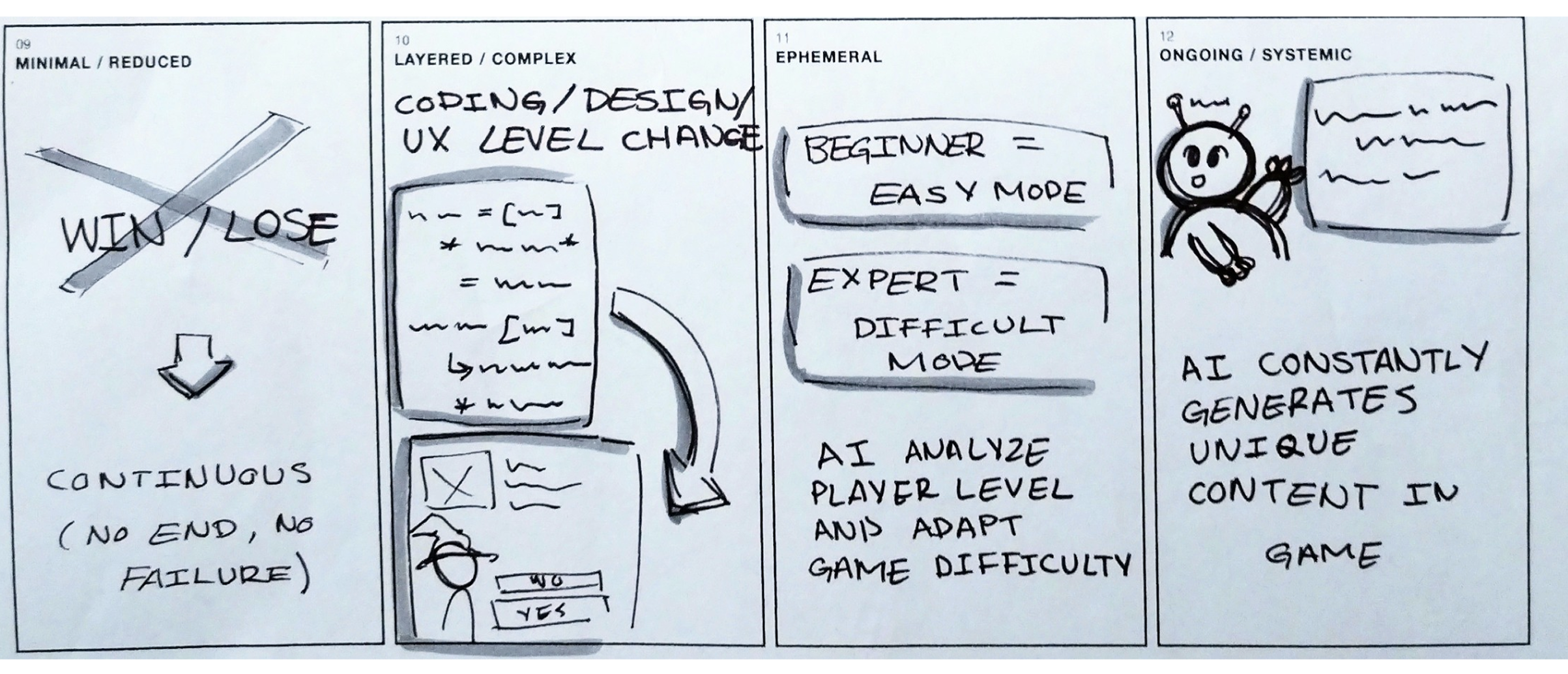
The Person — As a kid, I failed a lot of video games. These failure mechanics (win or lose, game over) actively discourage entry for younger and newer players, with long-lasting impacts on their emotional regulation around the concept of failure.
The Problem — Failure mechanics in game designs cause frustration and burn out, especially for younger players. The goal is to design game mechanics that move away from traditional failure as the main backbone of game functioning.
AI's Role — What if a game didn't have just one ending? Using AI to generate unlimited outcomes, every player decision has a realistic result. The game adapts continuously — there is no clear failure stage, only consequence, and the next move forward.
Implement
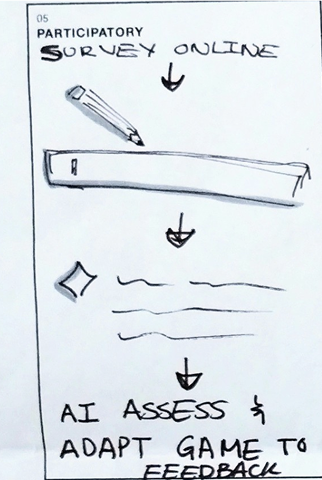
The first making move, before the loop tightened. Conversations with Claude and ChatGPT eliminated options that were too vague or undefined, and strengthened statements and ideas.
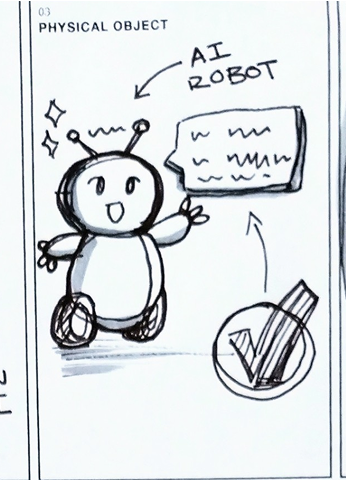
Convergence
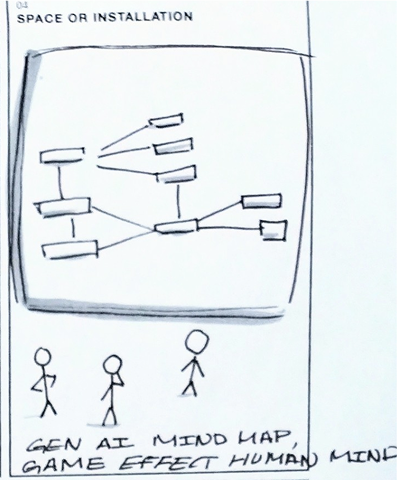
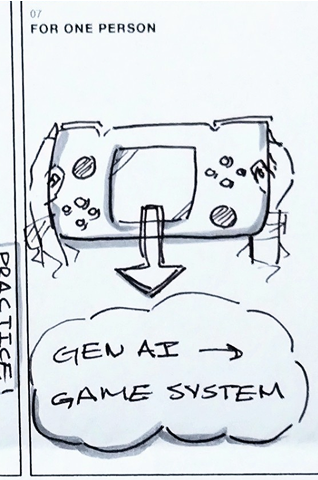
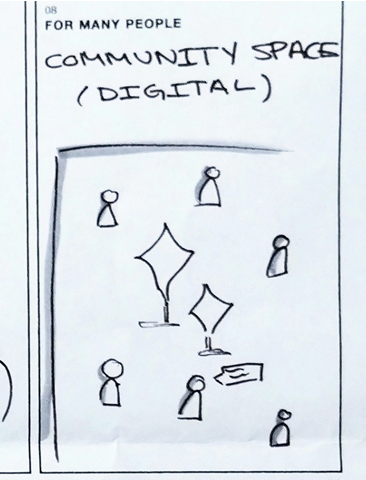
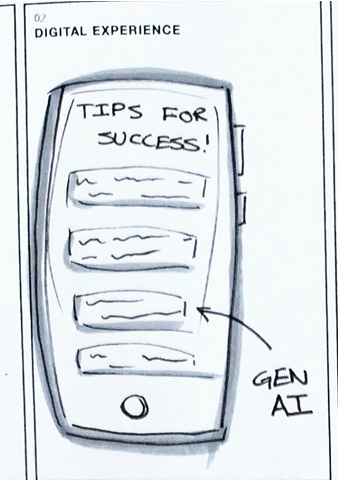
Looking at imagery and creating visuals related to the project helped take the concept out of imagination and more into reality. It allowed me to better understand which areas were weaker, and what areas needed clarification to answer certain questions.
Export from this run
This was the primary turning point of the project. It went from a video game system, to experimenting what could change in the system, to thinking of alternatives that can actually help more instances of the issue that exists in the world.
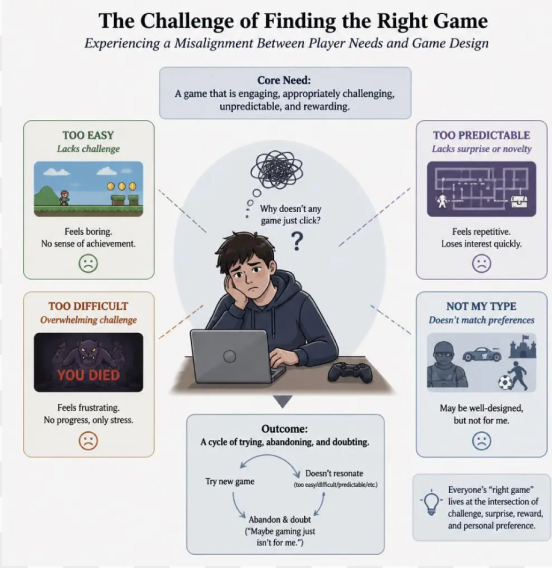
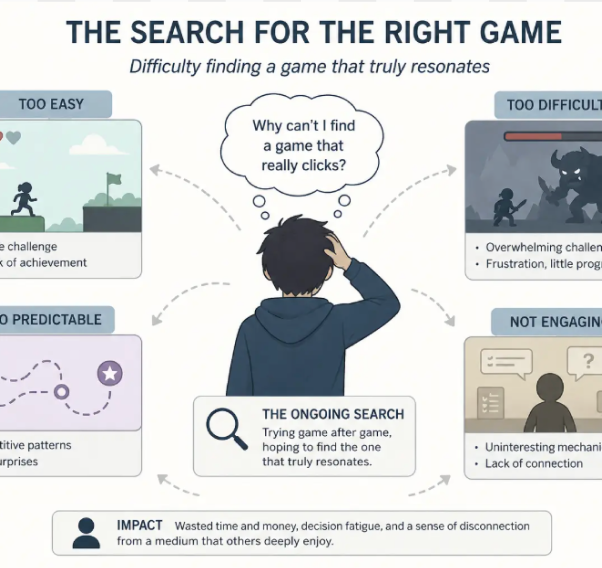
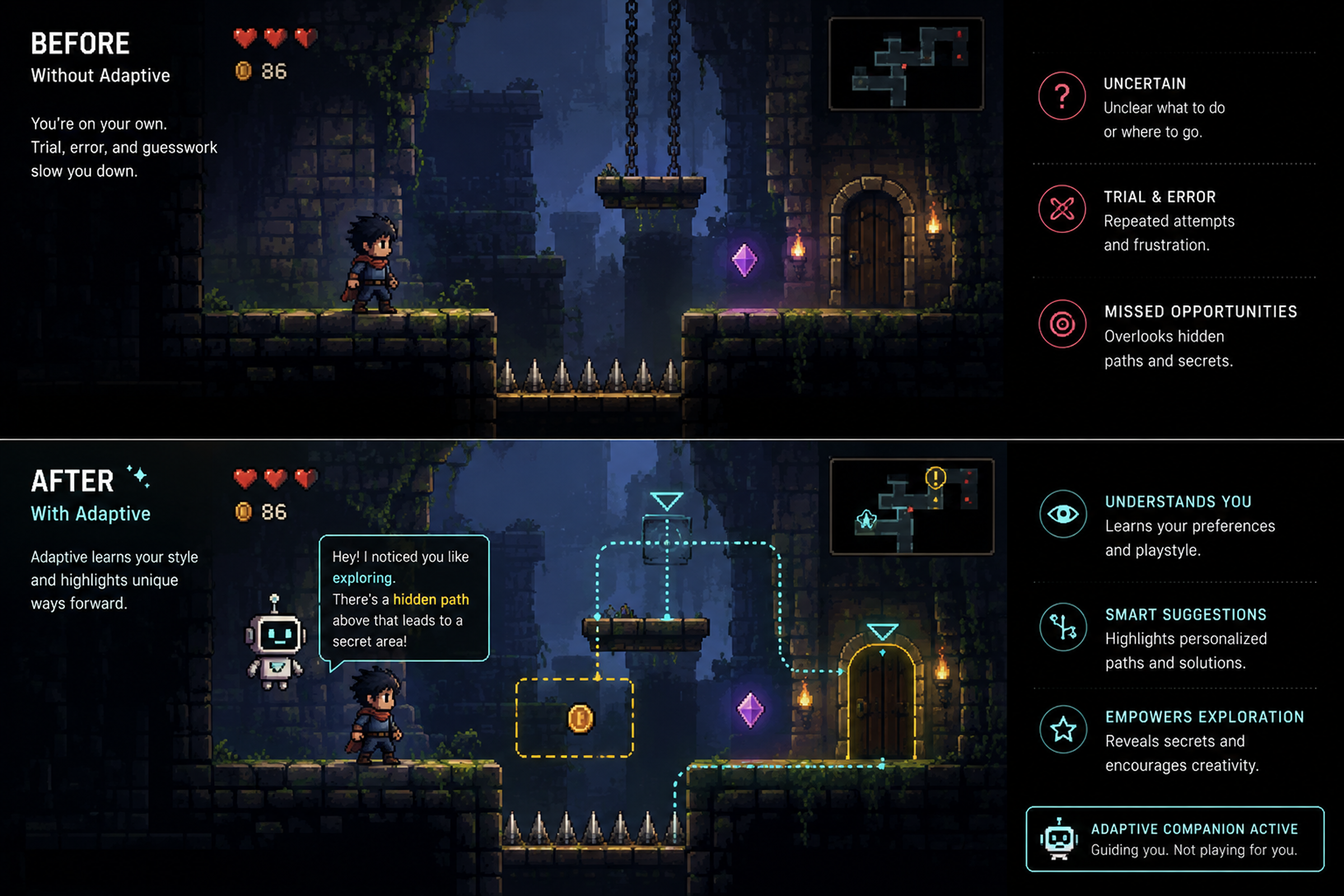
Two states. The player before encountering Adaptive — and after. The gap between them is the design problem and the design solution.
Before
Cloud before the intervention: dissonance between skill level and available games, no system built for how he plays.

After
Cloud after Adaptive enters: his playstyle is validated, his progress feels meaningful, trying something new feels exciting instead of impossible.
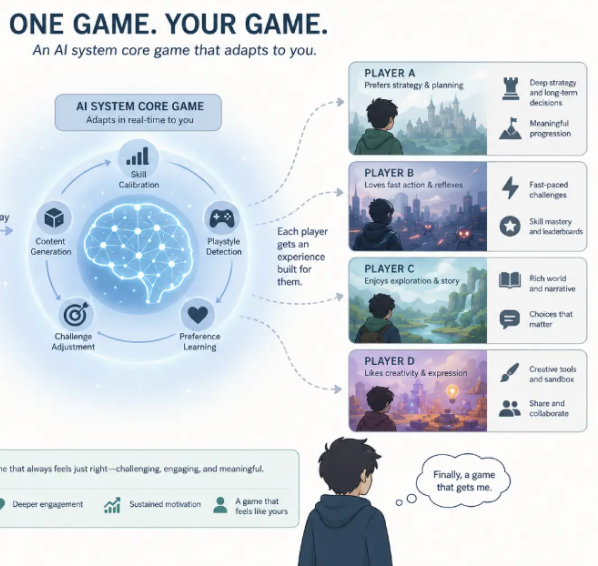


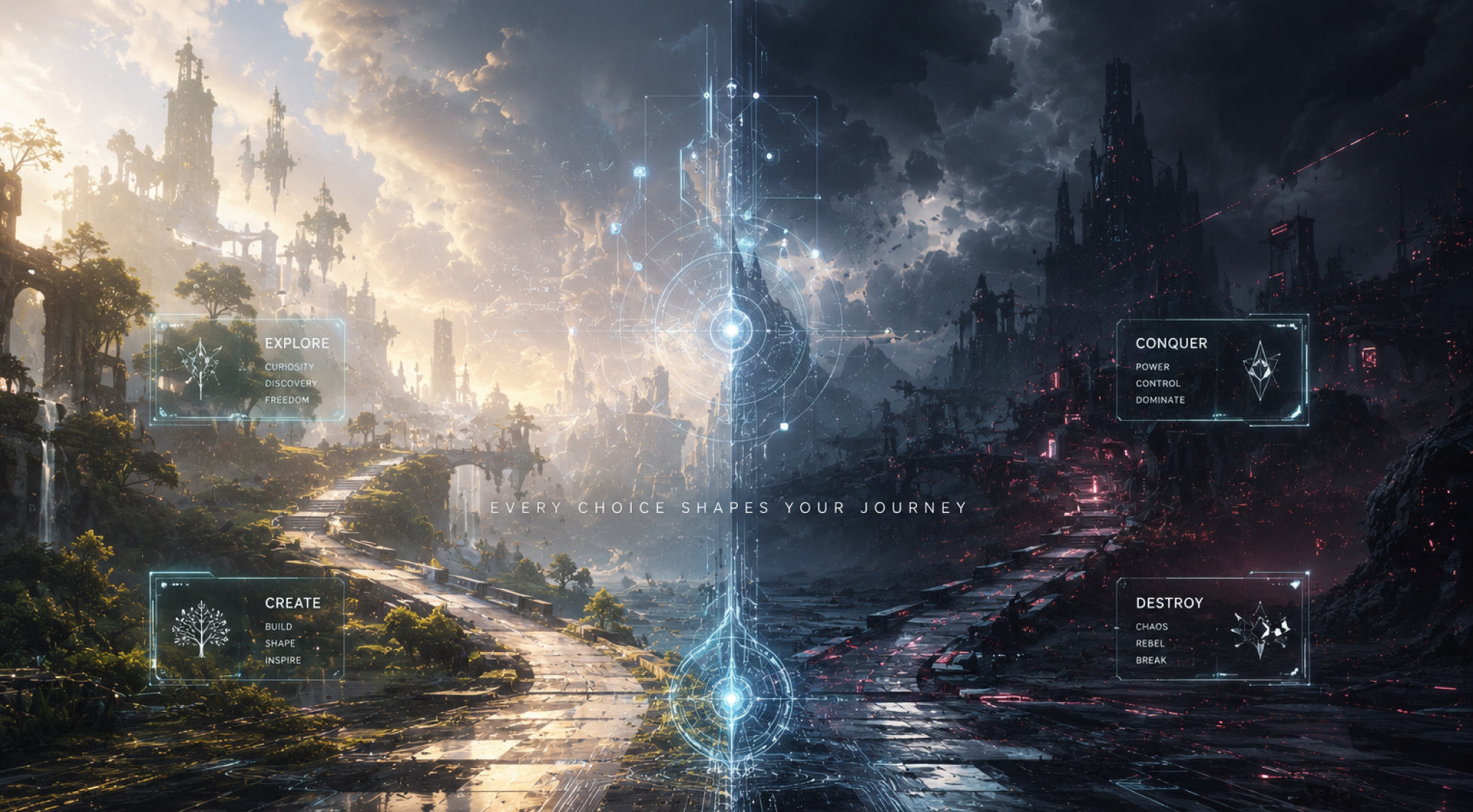
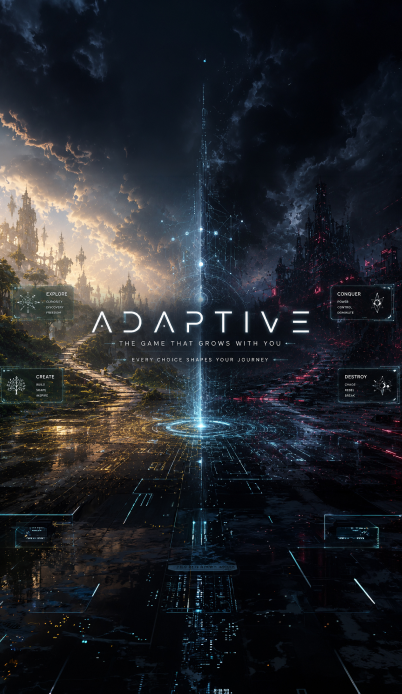
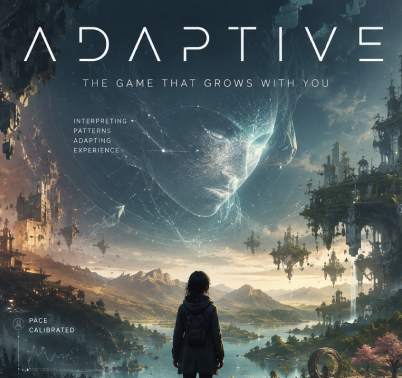
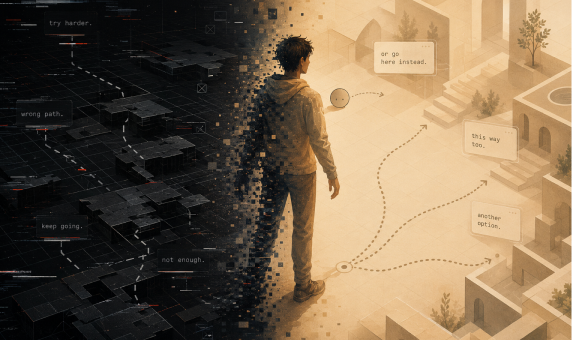
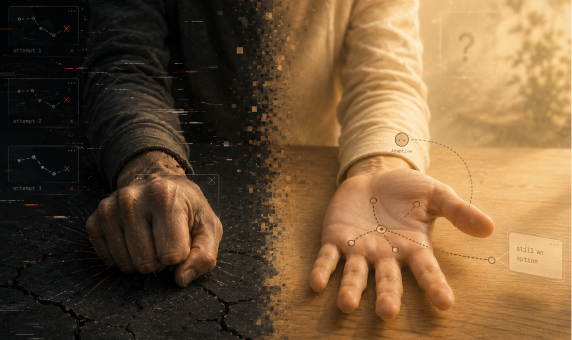
Three versions. Two simultaneous truths — the friction register and the support register — coexisting in the same frame.
What I Learned
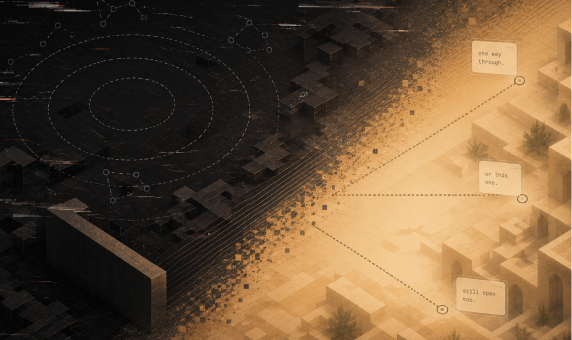
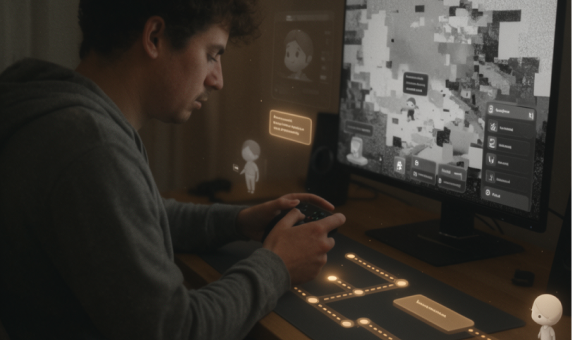
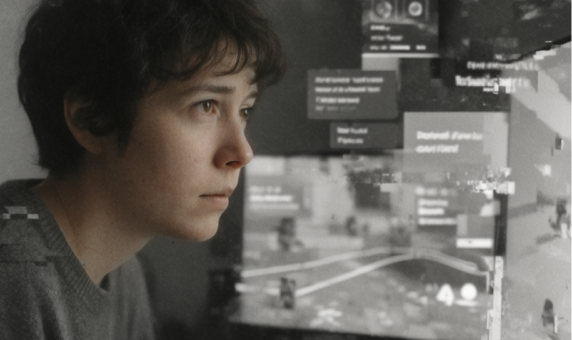
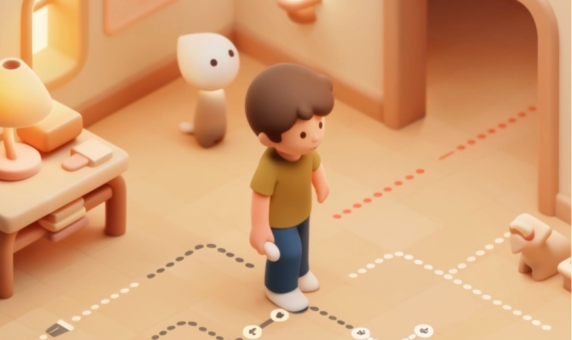
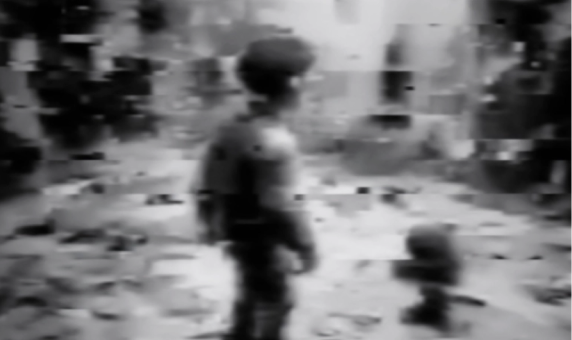
The visual world of this project lives between two registers — friction (black and white, glitched, fragmented) and support (warm, isometric, lit from within). Neither erases the other. The hero image had to hold both at once.
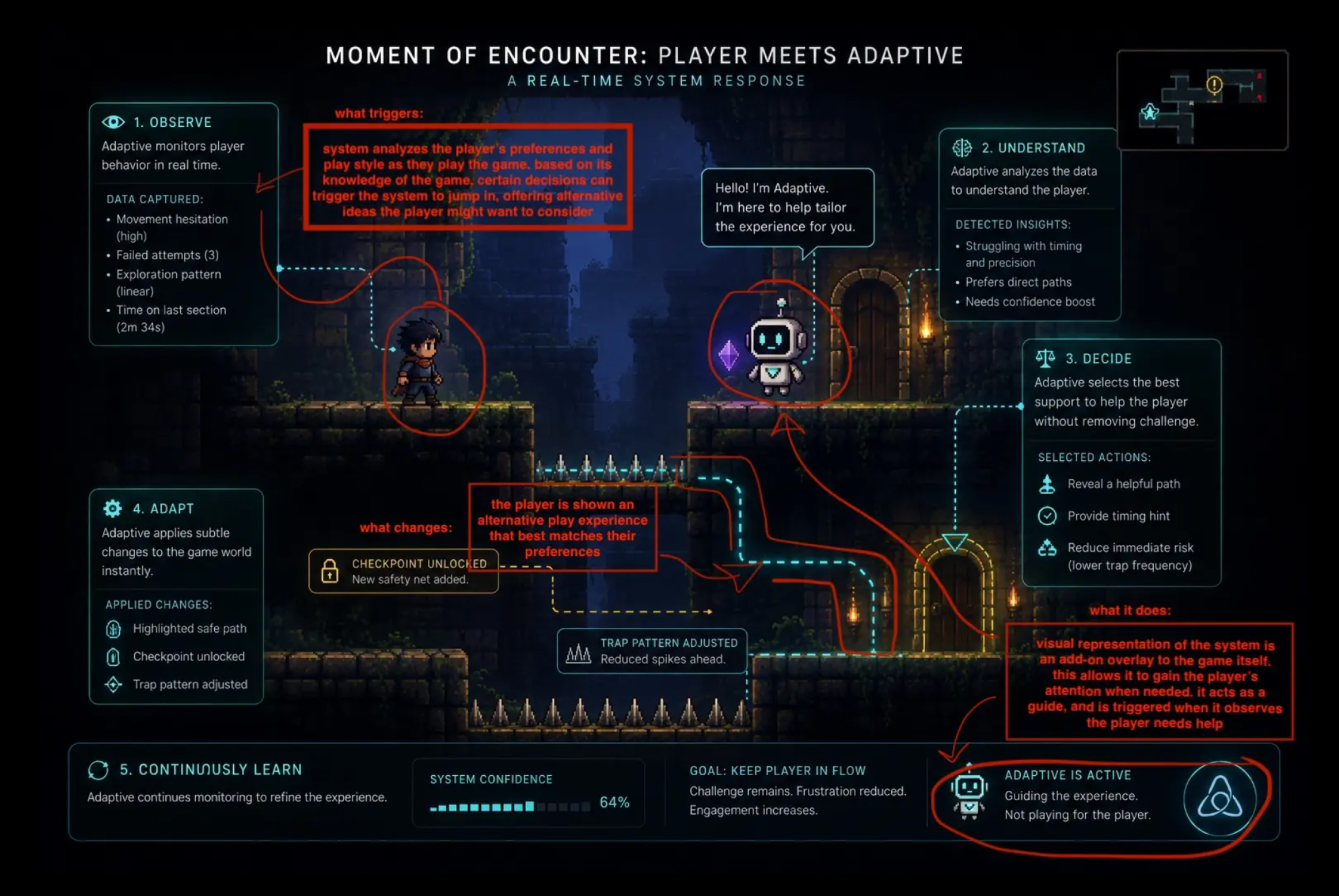
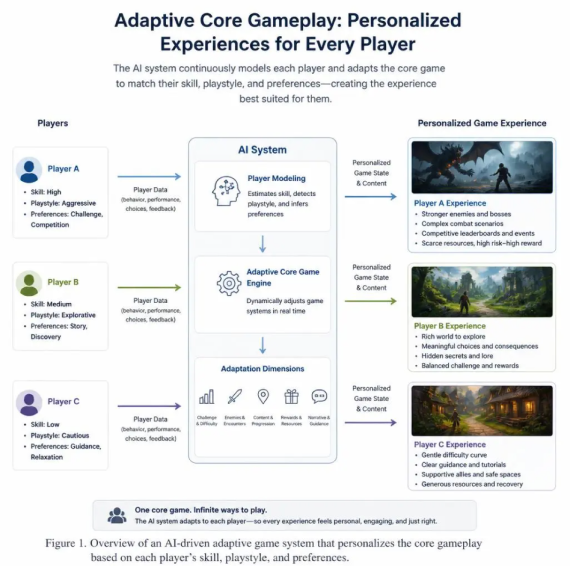
A schematic shows a more detailed and visual representation of how the project system works. A description alone cannot make visible what a diagram can.
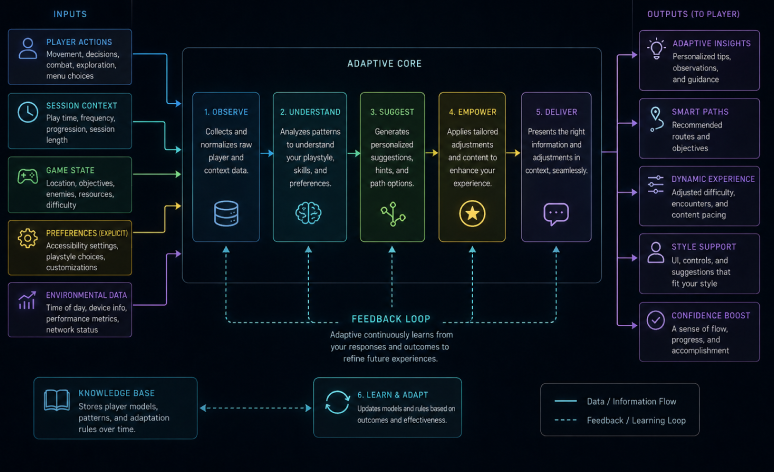
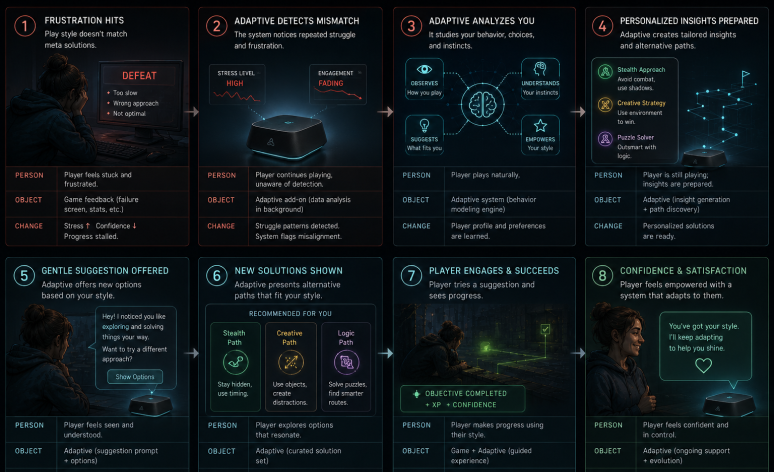
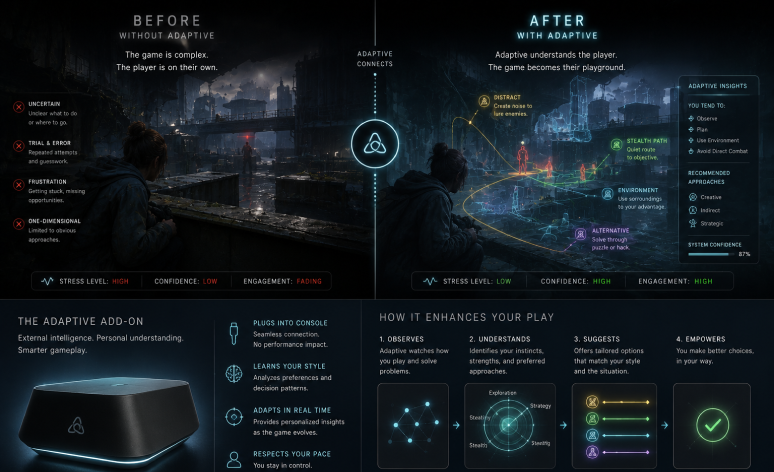
The companion observes how the player moves, decides, and responds under pressure. It builds a model of who they are as a player — not their preferences as stated, but who they are in motion — and adapts its guidance accordingly. The ceiling does not exist in this game because the ceiling in every other game was always the limit of what a human author could anticipate. This system anticipates nothing; it responds to everything.
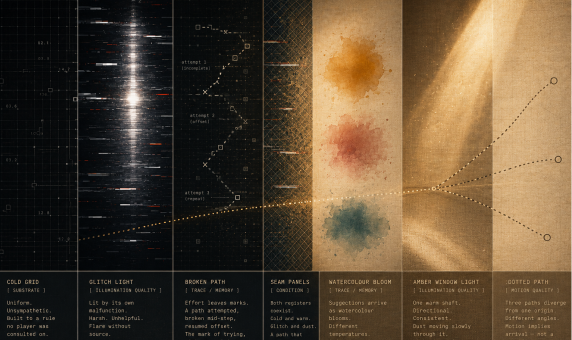
The visual world every image must belong to. Not a style reference — a set of rules every generation is measured against.
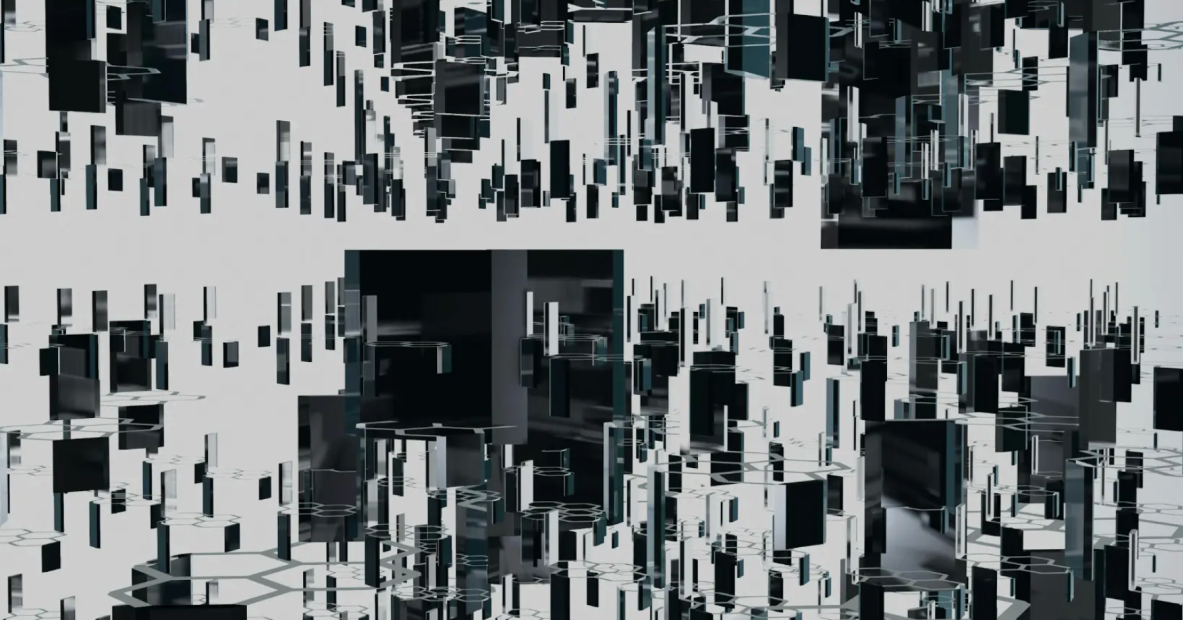
Strongest image from moodboard

Strongest image from moodboard
The world: This project lives inside two simultaneous truths. The first is the internal experience of a player who has failed — fragmented, uncertain, losing orientation inside a system that was not built for how they think. The second is the quiet presence of something that sees them anyway, and reshapes itself around them. The friction state and the support state are not opposites — they are the same moment, seen from two different distances.
The tone: The world of this project is private, close, and in constant motion. It does not perform for an audience. It follows one player — their specific hesitations, their specific instincts, their specific way of moving through a problem — and it stays near them without crowding them. The tone is supportive without being reassuring. Exploratory without being chaotic. Personal without being sentimental.
The companion: Adaptive is never the loudest thing in the frame. It does not lead. It does not correct. When it appears, it is smaller than the world around it, lighter than the environment it occupies, and quieter than the moment it enters. Its suggestions are not commands. They are openings.
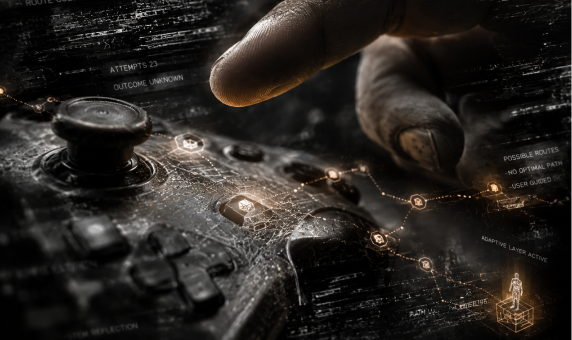
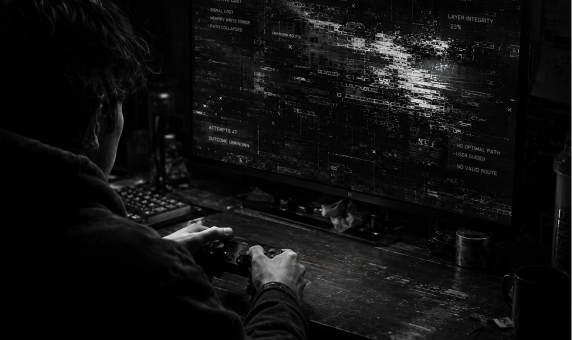
The visual register: Images move between two registers. The friction register is black and white, glitched, blurred, fragmented — the internal state of a player whose external efforts are producing no results. The support register is warm, isometric, lit from within, guided by dotted paths and spare UI elements that reveal options without imposing them. These registers are not sequential — they are the coexisting emotional reality of a player who is still inside the experience, still deciding, still moving.
Visual Register — This or That:
12 shots. What worked: Claude and ChatGPT gave images relatively aligned with the project direction. What didn't: generation limits pushed production pace back and created inconsistency. The resolution: a pivot to analog hand-drawn methods to maintain output quality.


What I had to let go of
I had to let go of creating a video game system. I moved away towards a one-problem-one-solution idea because it wasn't actually solving the problem I was proposing. My rate of output for project materials was ultimately higher quantity and quality using analog drawing methods than what limited AI generation could give me.
Storytelling
Four beats. Who Cloud is, the moment the gaming world fails him, Adaptive entering the scene, and what remains after.
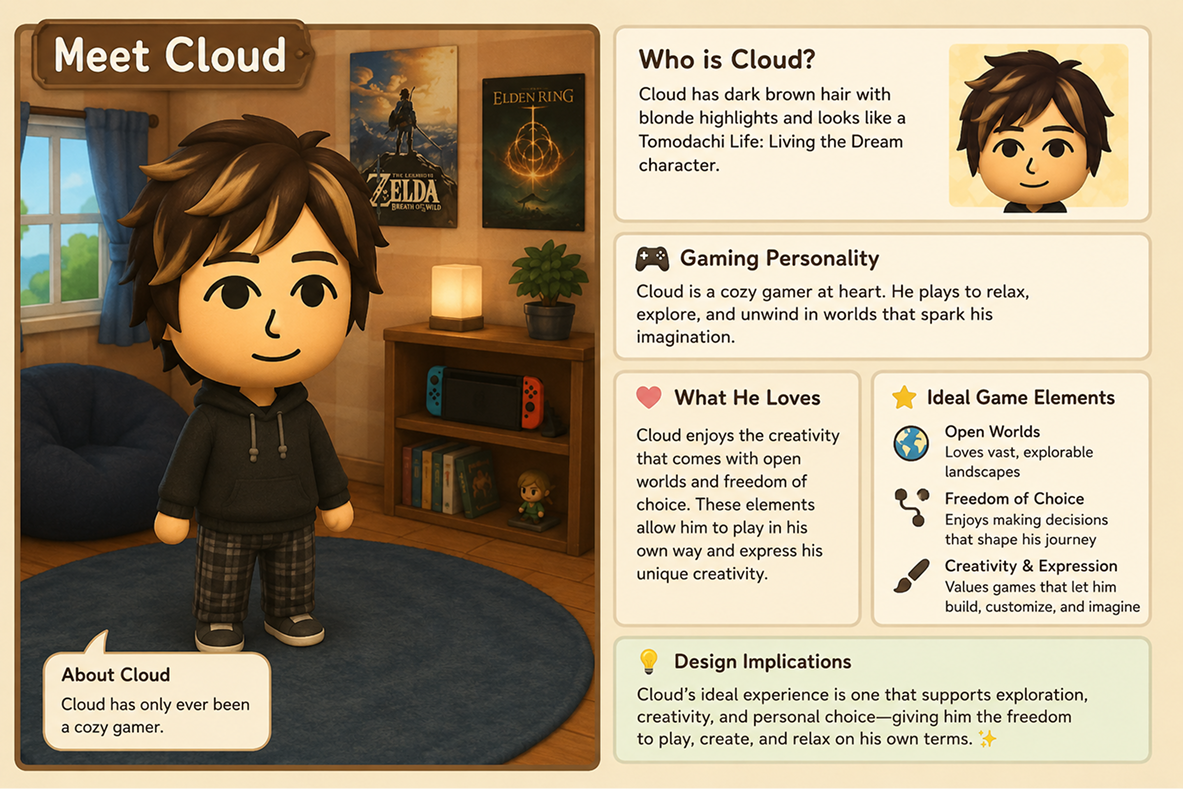
Cloud has only ever been a cozy gamer — he enjoys the creativity that comes with open worlds and freedom of choice, which are ideal for his unique playstyle.
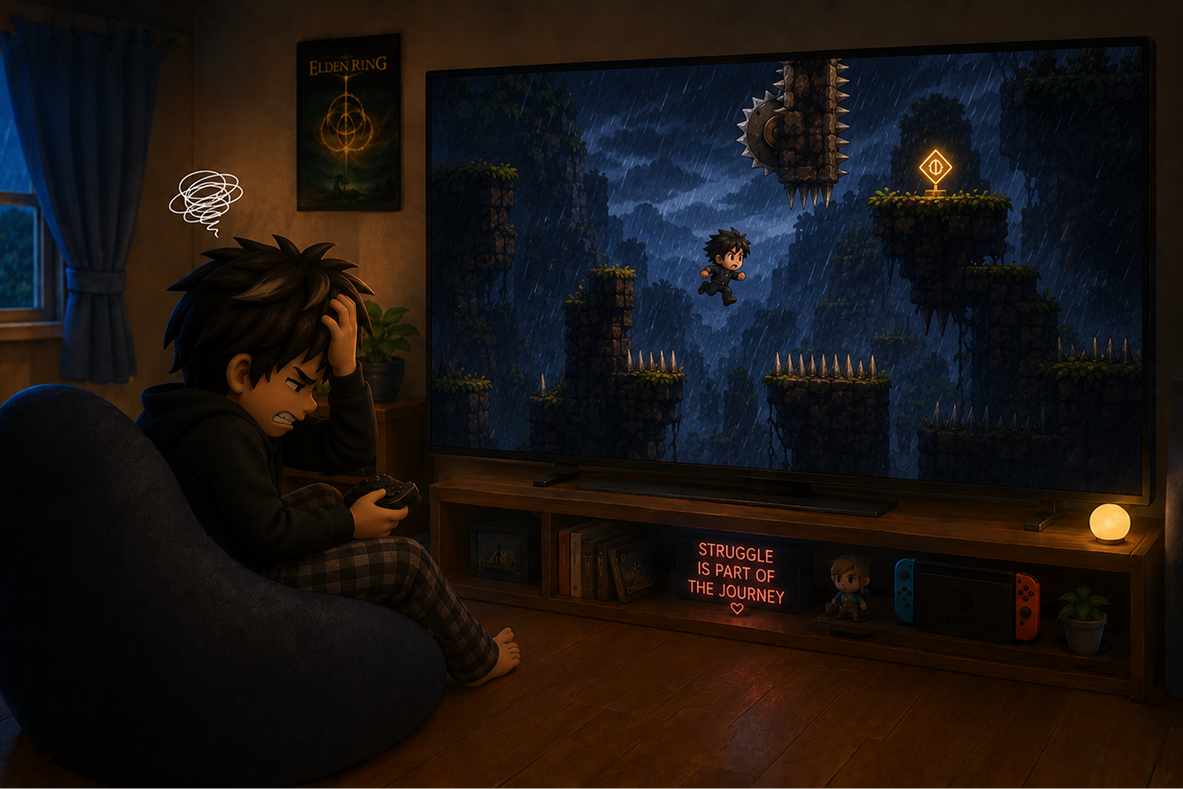
Cloud wants to try other genres, but struggles with the skillset difference. He looks online for help but finds dissonance — advice is targeted towards higher level gamers, the language too advanced for a beginner like Cloud.
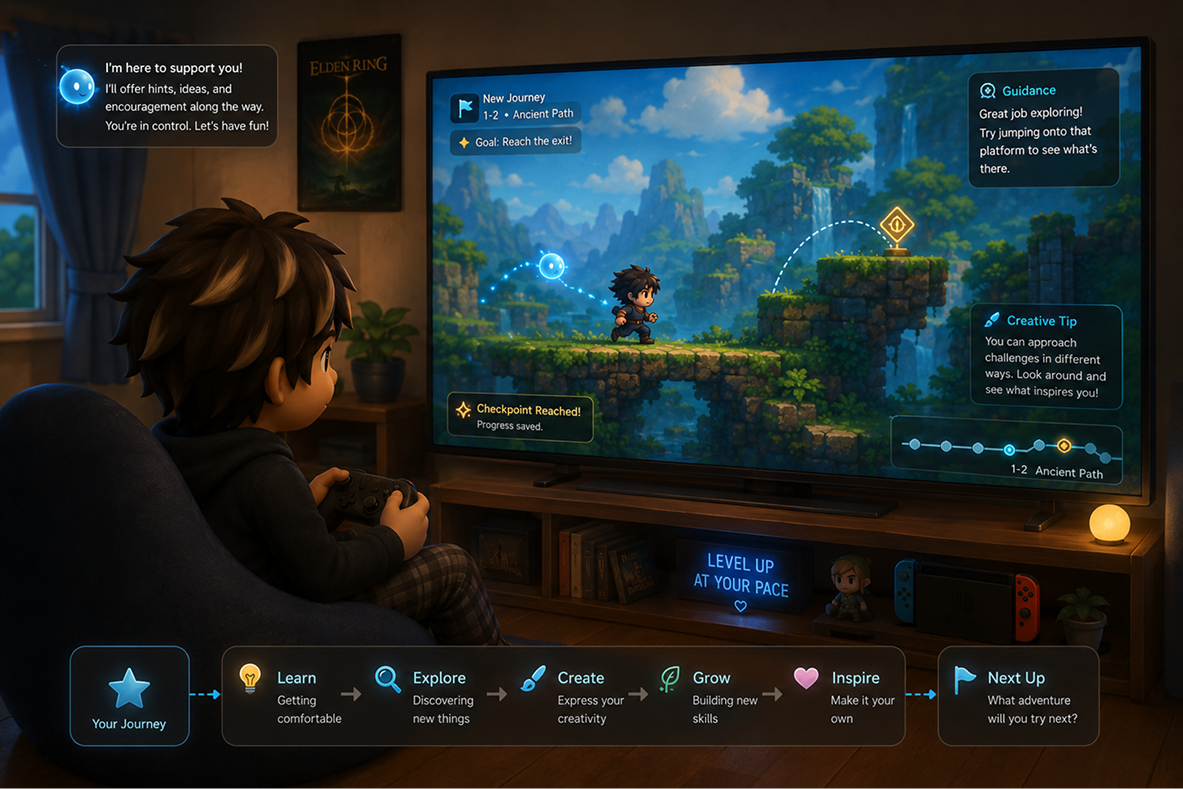
A companion to the player: through analysis and observation, it gives tailored quests and guidance that rewards creativity and skillset growth. A digital support system Cloud can turn to without fear of judgement.
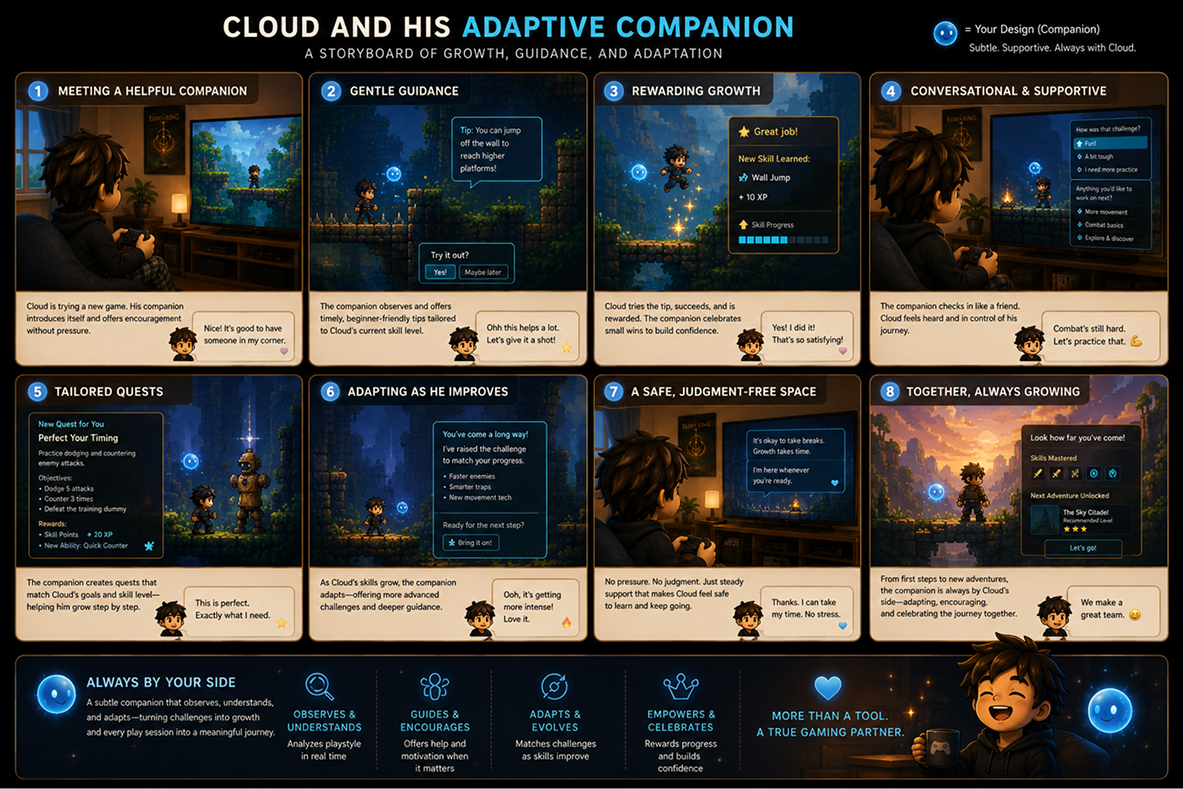
Through this design, Cloud can grow his skillsets and the design will adapt alongside him. As Cloud's skills become more advanced, Adaptive will tailor more quests that fit his requirements.
TedEd style voiceover and video. Animating the video personally better communicates the authenticity of the person's problem and how the design intervention changed their outlook. By keeping it simple, the story reaches the audience informatively and briefly.
Evaluate
Working with AI throughout a project was a really unique experience that allowed me to widen my perspective on what creating a design from the ground up requires of the designer. With AI, I was able to better synthesize my ideas and focus my project direction. Together, we were able to create a design that answered the initial question I posed for myself when starting the project.
Working with AI has taught me to be more open to criticism and feedback because it allows you to embrace new possibilities that you could have never considered otherwise.
Week 1: Before
I believe the first time I encountered something resembling AI was likely when I watched the original Star Wars trilogy. C-3PO set up a lot of expectations — I thought all robots would have that level of intelligence, personality, and individuality. My first encounter with the modern AI we see today was with ChatGPT. Uncertainty over what AI "was" made me very cautious. Because of my strong sense of personal skills with writing and art, I never felt the need to use generative AI.
Week 10: Now
I know how experimental and frustrating a project that I envisioned and created can be to synthesize into something real — but can understand how rewarding it feels to overcome those mental hurdles and face difficult problems head-on.
Class Gallery
A breadcrumb trail across the process. Not polished. Real. Every image here is a decision point.
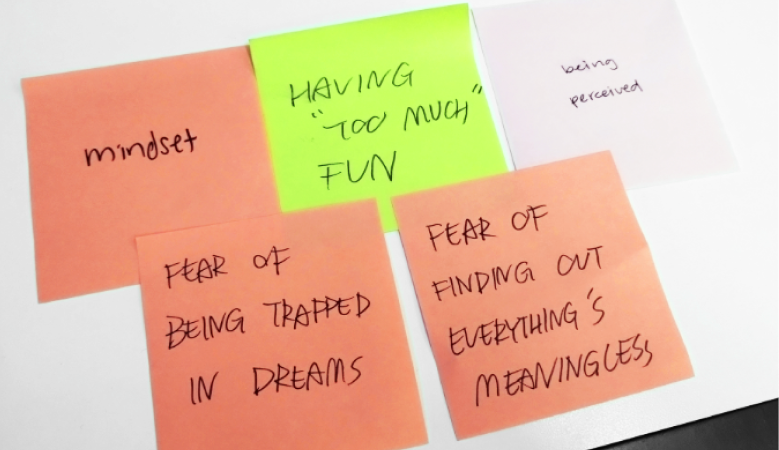
Person Interaction — shows how the player interacts with the design.
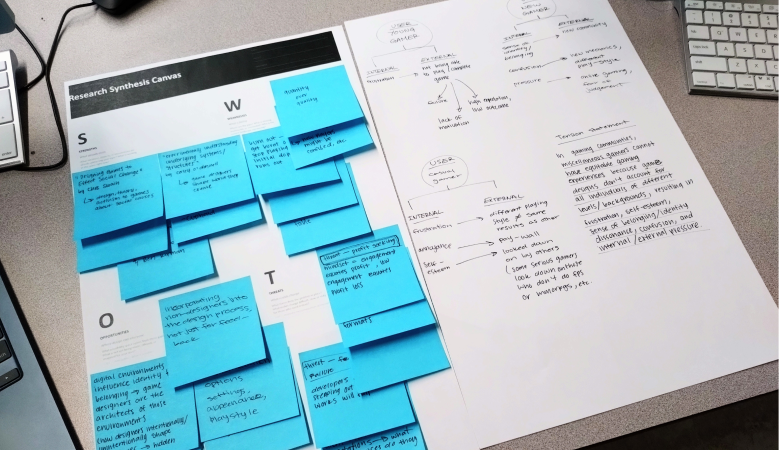
Early-Stage Hero Image — shows the line between game difficulty, genre, and player choice.
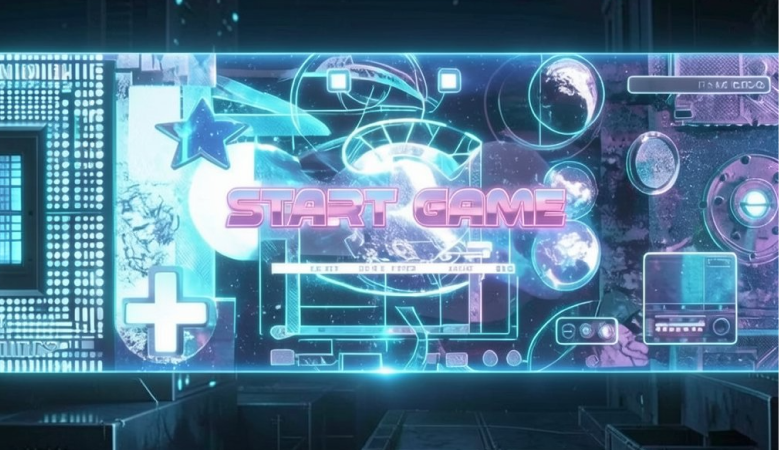
Before and After — shows the player's life before Adaptive and after Adaptive.
Moment of Encounter — the moment the player meets Adaptive and the criteria it analyzes to tailor the game.
System Diagram — shows the behind-the-scenes system workings that Adaptive considers.
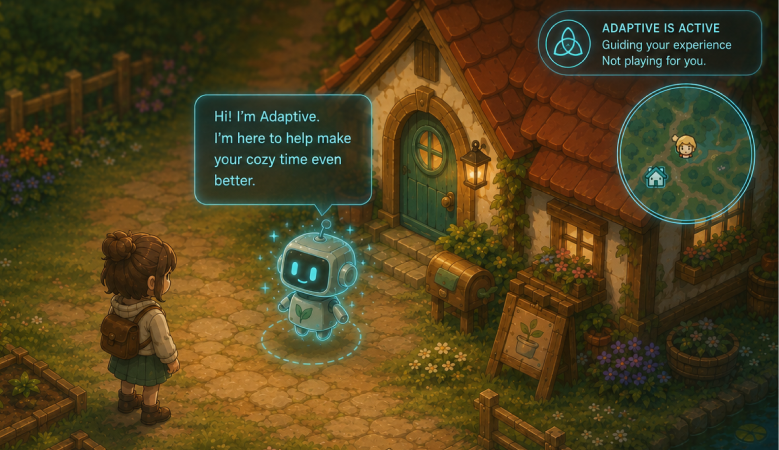
Genre Alternative Prototype — shows Adaptive's ability to be used in multiple game genres and situations.