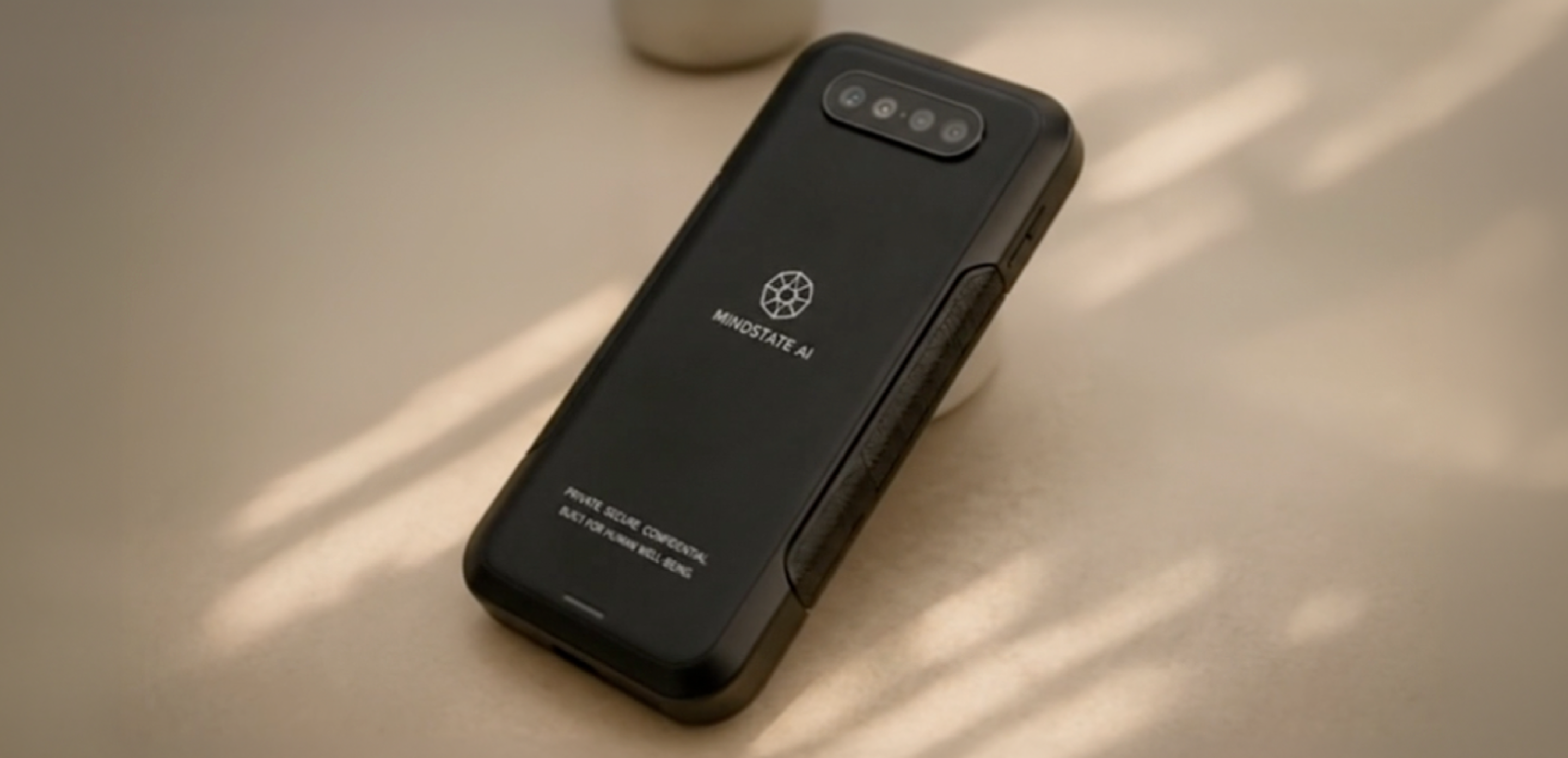
A handheld workplace device that uses AI to detect exhaustion and burnout in team members through logged input and AI-powered facial scanning and thermal imaging — pushing people to take action and accountability for neglecting emotional needs. Designed for John, who often neglects his health due to pride and fear of being perceived negatively in the workplace.
Gather
Six levers set the parameters for how AI would operate. The focus: individuals pursuing material success while neglecting personal goals such as happiness, peace, and well-being.
A research partner with a focus on the field of design, catered to explore individuals pursuing material success, neglecting personal goals such as happiness, peace, and well-being.
Help think about how to better ideas within the current direction — pushing toward the next level, not generating in place of the student.
Push to take ideas to the next level. Offer critique in areas where the how, why, and visuals in design are lacking.
Be straightforward, concise, and not repetitive when offering answers. No padding, no restating what was already said.
Don't form opinion-based suggestions. Provide answers based on logic, reason, and facts. Don't make assumptions.
Keep returning to the existing tensions between success vs. the pursuit of happiness and well-being.
Your prompt
"I was thinking of creating an all-in-one platform that integrates both personal and material goal organization, journaling, task tracking, and rewards effort and progress."
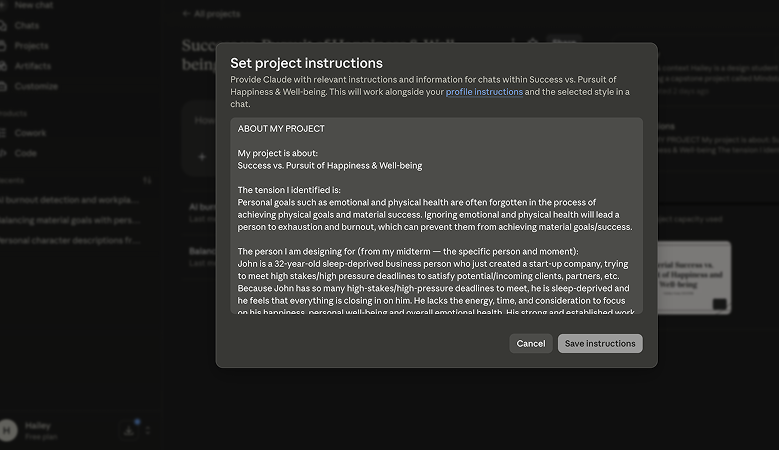
Claude — 5 directions you haven't explored
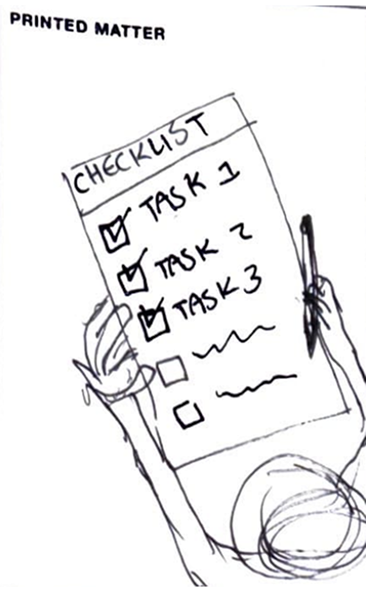
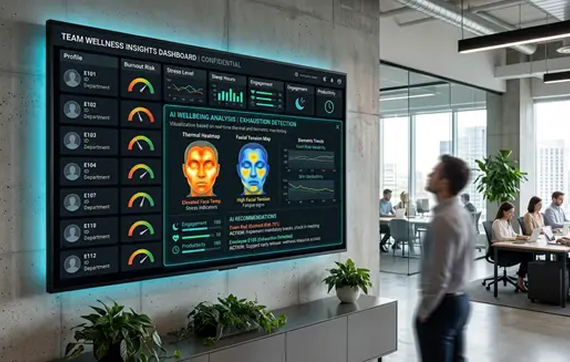
"1. A physical object that makes inaction visible. 2. An environment that degrades. 3. A system that withholds, not rewards. 4. A letter John writes to himself in the future. 5. A public dashboard that exposes John's imbalance to his team. Before I push further — which of these makes you most uncomfortable, and why?"
What it changed
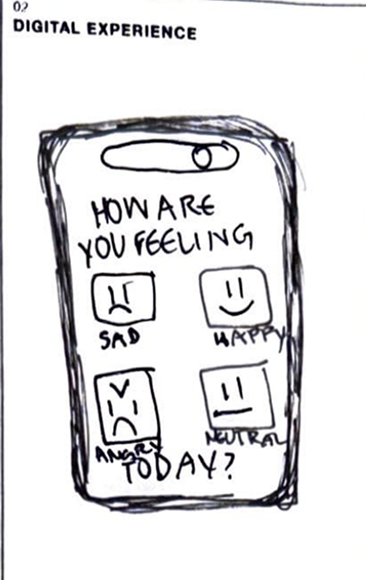
I noticed that my mind had been a little closed off to a lot more possible design interventions. I was very fixated on creating something digital. This experiment opened me up to creating a physical object or encouraging physical tasks such as writing letters to oneself.
Success vs. the pursuit of happiness — people will become burnt out and miserable as a result of not focusing on their well-being. At some point, these people could become miserable enough where they aren't able to achieve their overall goal.
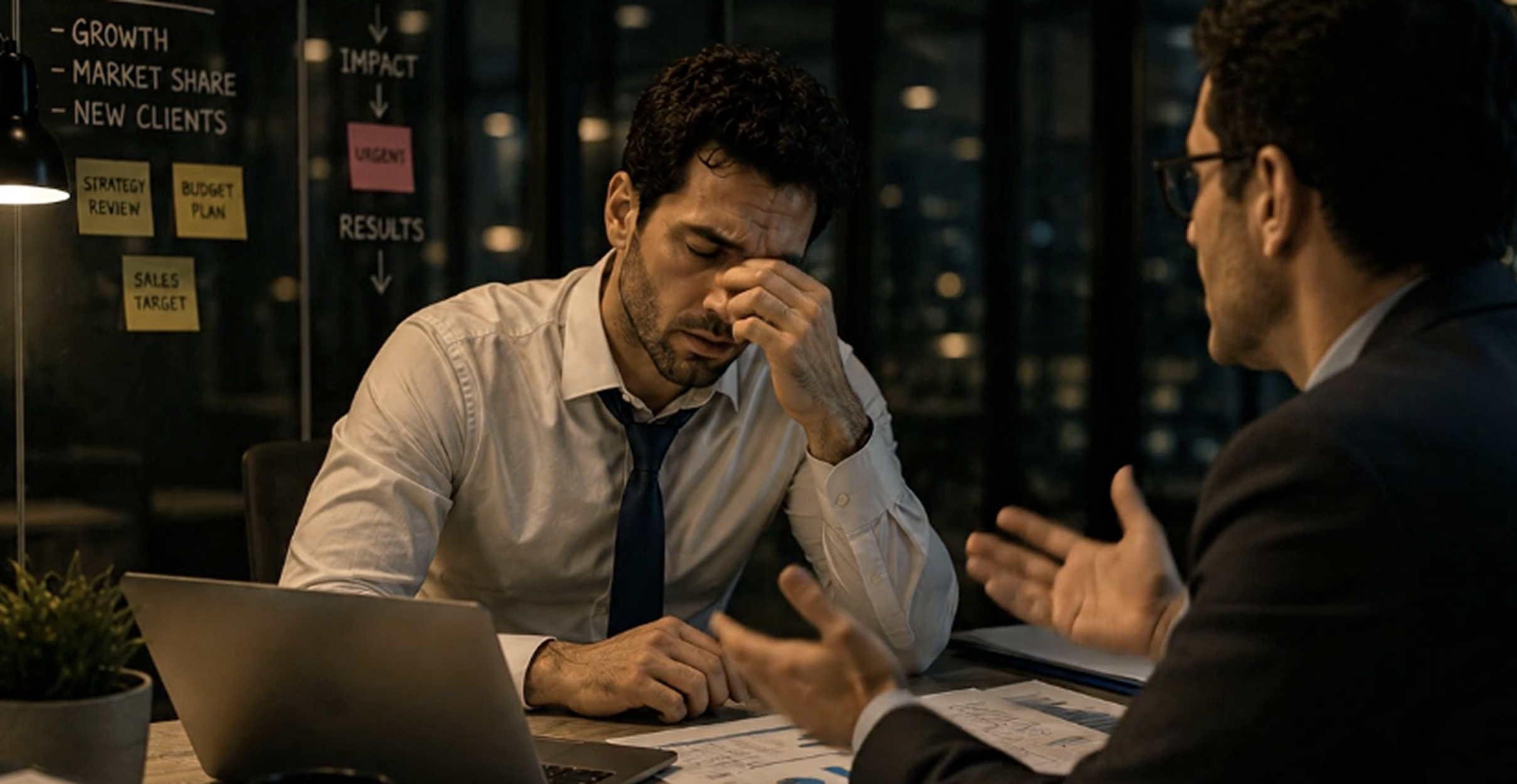
In high-stake or high-pressure situations, John cannot work on his emotional health and mental well-being because he is too focused on creating a successful business, resulting in ignoring feelings of exhaustion, burnout, and sleep-deprivation.
I am interested in what happens to people when the drive to succeed quietly crowds out everything else — the rest, the care, the connection — and why we keep letting it.
Explore
Three sources shaped the direction. What they revealed together: people who chase external markers of success become miserable enough that burnout eventually prevents them from achieving those same goals.
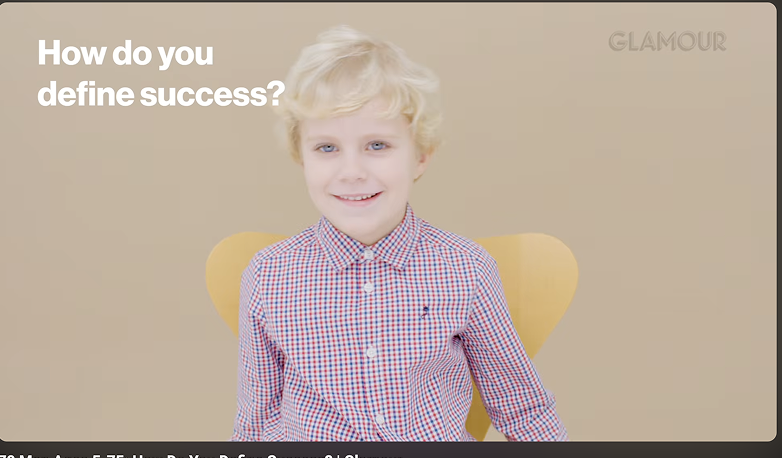
YouTube
70 Men Ages 5 to 75 on What Success Means
As age increases, men shift from defining success as money and independence toward emphasizing intangible goals — happiness, fulfillment, loving themselves, and having peace.
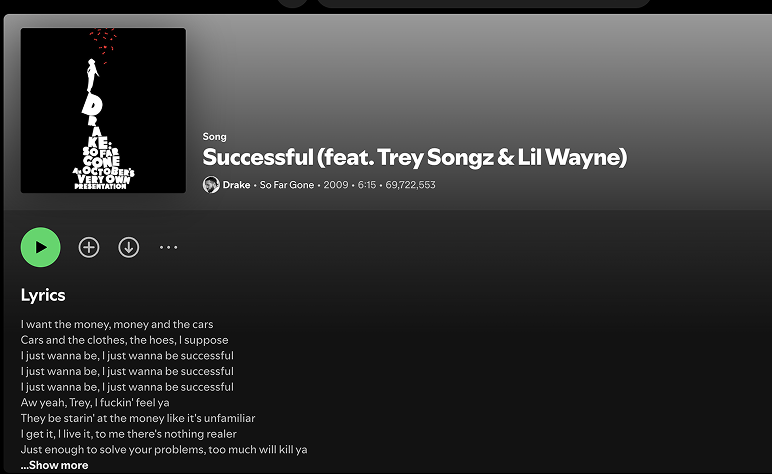
Music
Successful — Drake (feat. Trey Songz & Lil Wayne)
Places emphasis on the luxurious and fast lifestyle — money, cars, clothes — associating all of it with success. The lyric "I don't want the glow, I want the glory" reveals an early realization that visibility is distinct from substance.
Book
Atomic Habits — James Clear
Highlights the importance of building something big with small goals. You can't achieve the bigger picture goal without the smaller ones — smaller goals compound over time. "You fall to the level of your systems."
Your prompt
"Push further on the public dashboard idea. What draws me back to it is the invasion of privacy and how this will help John stop pursuing his material goals in exchange for taking care of himself."
Claude
"The invasion of privacy is exactly what gives this direction teeth. But you're skipping a step. You said it will help John stop. Why would visibility to his team actually stop him? John's identity is built around proving he can succeed. Exposing his burnout to co-founders doesn't just create accountability — it creates shame. And shame, for someone with John's work ethic, is more likely to make him push harder to appear capable than to slow down."
What it opened
The problem lies within John's inability to admit his decline in emotional and physical health because he takes a lot of pride in his work and doesn't want to be perceived negatively. This causes him to neglect his emotional health and well-being — which leads to decline in work quality and eventually hinders his ability to continue working towards his goals.
Narrow
There's an opportunity to shift John from having a result-driven mindset, dismissing burnout and exhaustion, to acknowledging progress and prioritizing well-being during high-stake situations — by providing a platform that makes it easy for John to focus on maintaining well-being while working towards his goals.
How might we help a sleep-deprived, exhausted, and burnt-out business person acknowledge progress over outcome while also prioritizing goals deemed less important by society — like maintaining emotional health and wellbeing?
How might we provide resources that encourage pursuance of maximizing happiness and well-being, while also celebrating progress for an exhausted and burnt-out business person?
How might we create automated and adaptive features that boost morale in difficult and busy situations?
John — Age 32. A sleep-deprived business person who just created a start-up company, trying to meet high-stakes deadlines to satisfy potential clients. He feels that everything is closing in on him. He lacks the energy, time, and consideration to focus on his happiness, personal well-being, and overall emotional health. His strong work ethic doesn't allow room for failure. He pushes himself to keep going because he sees that failure isn't an option. As a result, he doesn't allow time for personal well-being.
Making a commitment
Room Feedback
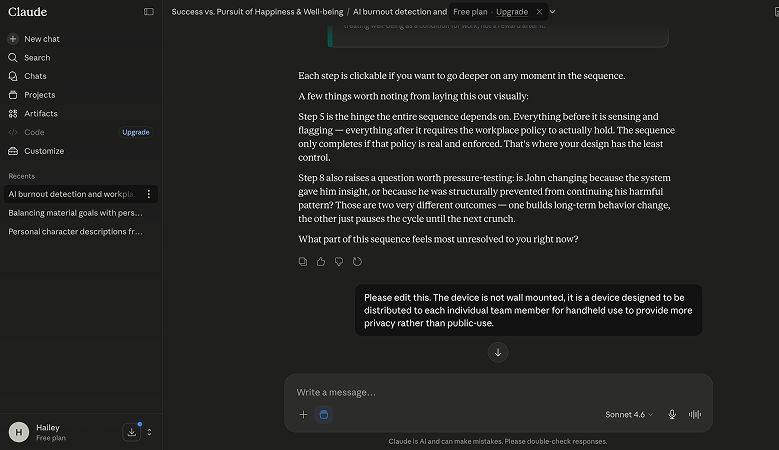
The room was not quite sure what was being built, but thought the idea of an AI device was interesting. After presenting, the direction shifted from a public AI workplace dashboard to a more privately used device designed to be distributed to each individual team member — preserving user privacy while still creating accountability.
As an individual who has experienced the overall problem of prioritizing material success vs. personal goals from a young age, I understand the difficulties and issues that come with it. I am committed to exploring the possible solutions and strategies that could make it easier for individuals like myself to manage and achieve goals in a healthy way. I would also like to further explore the use of AI and how it can be used as a tool to make lives easier regarding this issue.
Implement
The first making move. The device had to feel real and commercial — not like concept art. Each generation sharpened what the product needed to communicate.
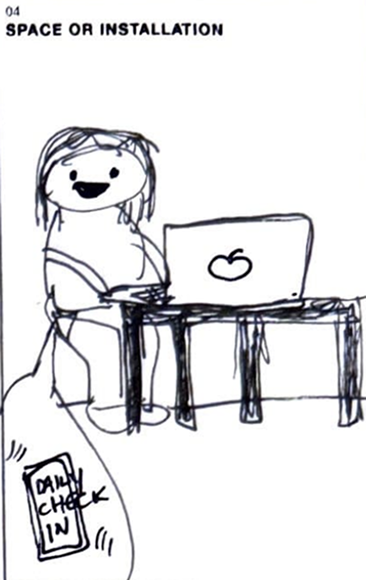
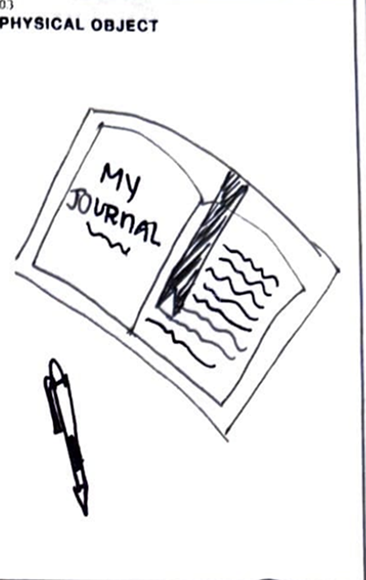
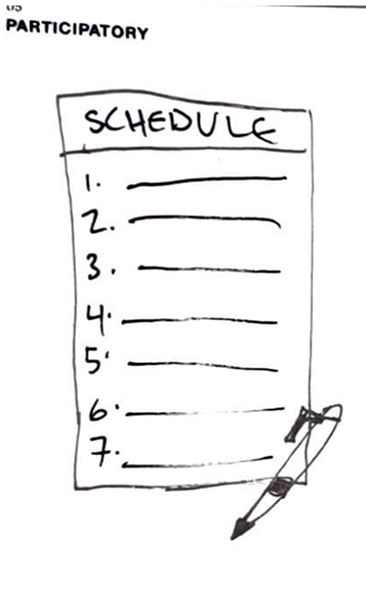
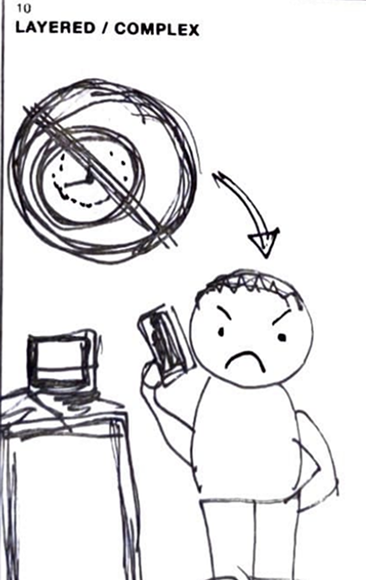
What the first loop showed
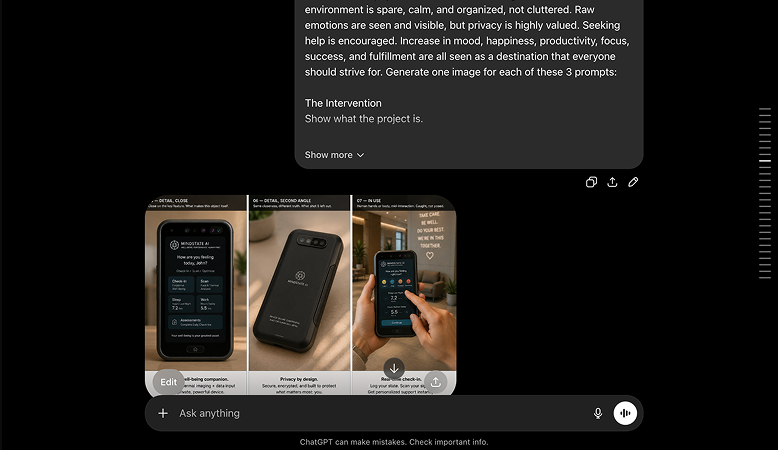
I expected the AI to produce a realistic, commercial or ad-like feel with people interacting with the product — but the first loop showed something more simplistic and general. Providing the AI with one specific seed to develop a set of pictures is an efficient way to ensure the images come from the same world.
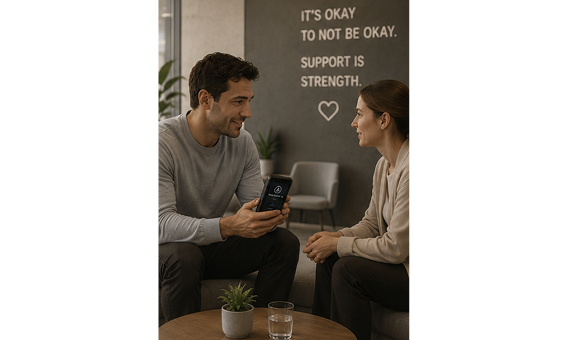
Generating these images established what the device's intervention looks like before and after. The before images capture the state the device is designed to detect; the after images capture the change it creates.
Before
John before the intervention — unacknowledged burnout, no accountability, the state the device is designed to catch.
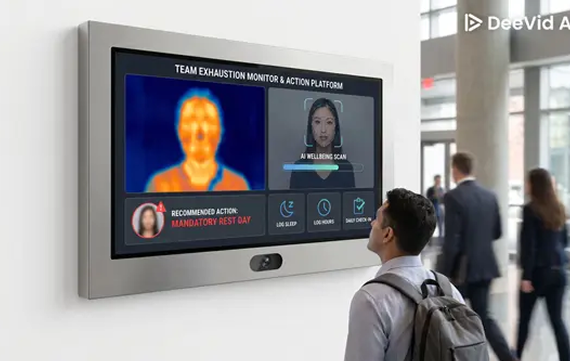
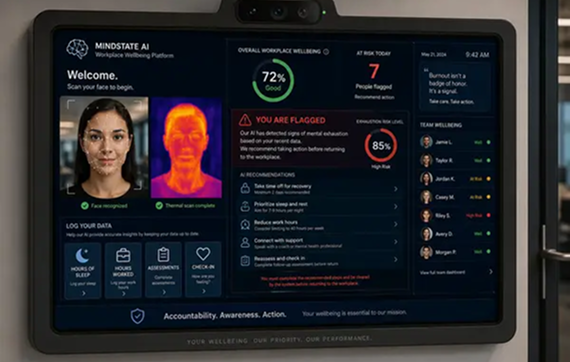
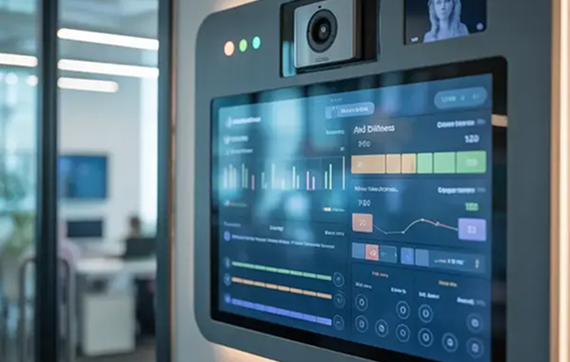
After
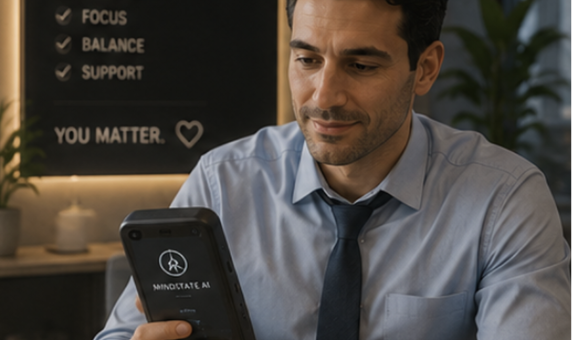
John after engaging with Mindstate AI — the device flags the state, creates accountability, and the moment of action becomes possible.
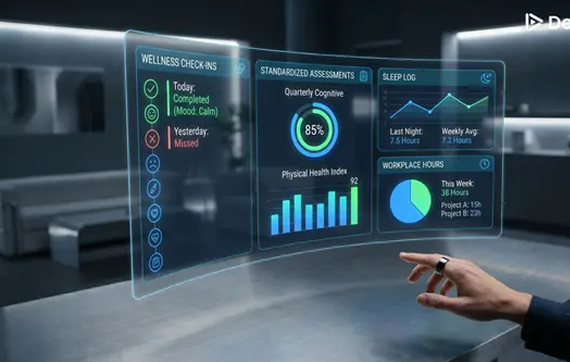
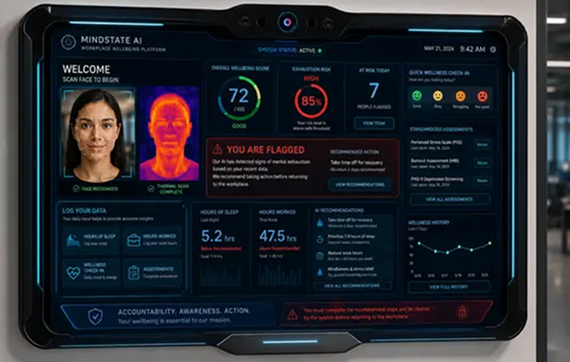
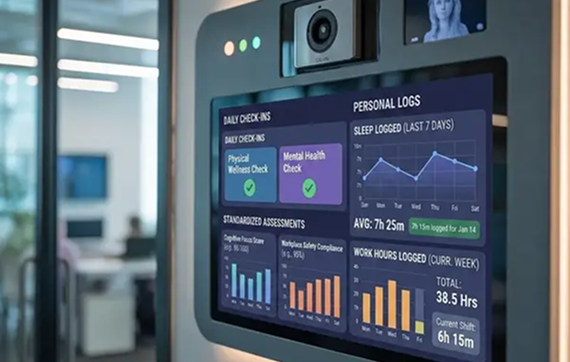
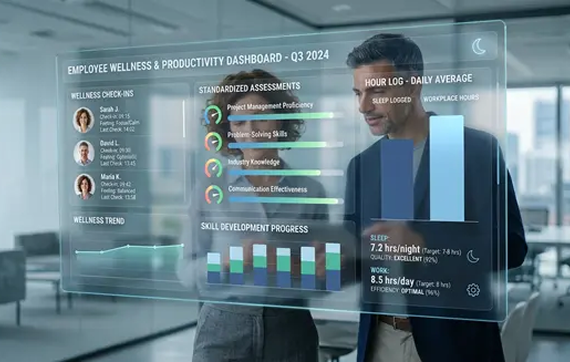
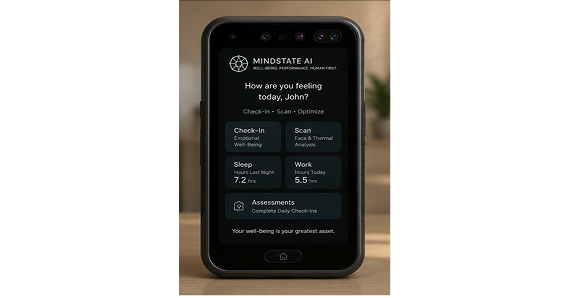
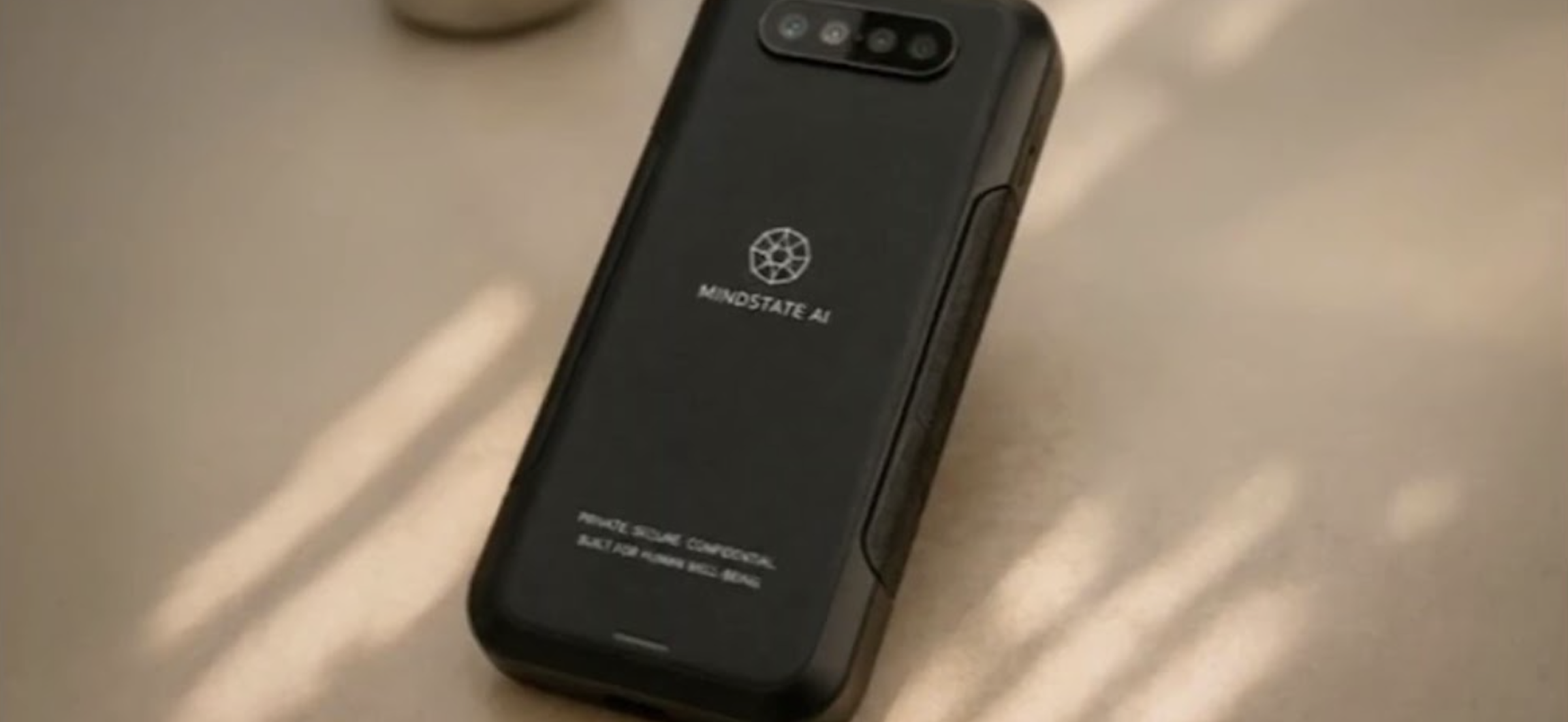
Three versions. Each one tested how the device communicates weight — something clinical and serious — without looking like a medical instrument nobody would pick up.
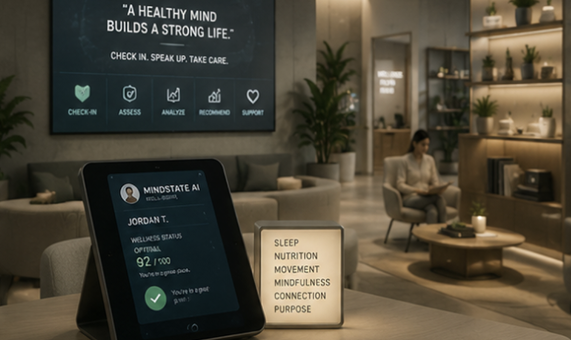
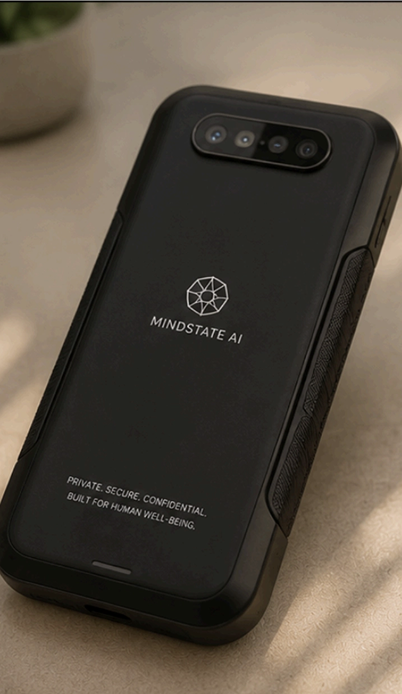
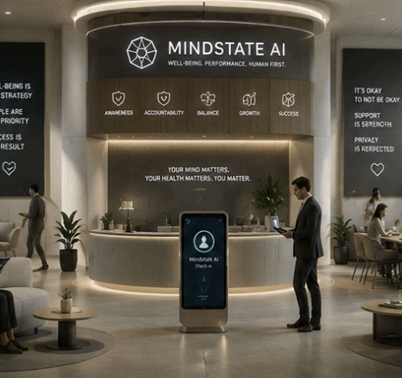
What it revealed
The device needed to read as personal rather than institutional. The landscape framing pushed it toward product photography; the tighter crops pushed it toward something you'd actually hold. The final hero came from that tension.
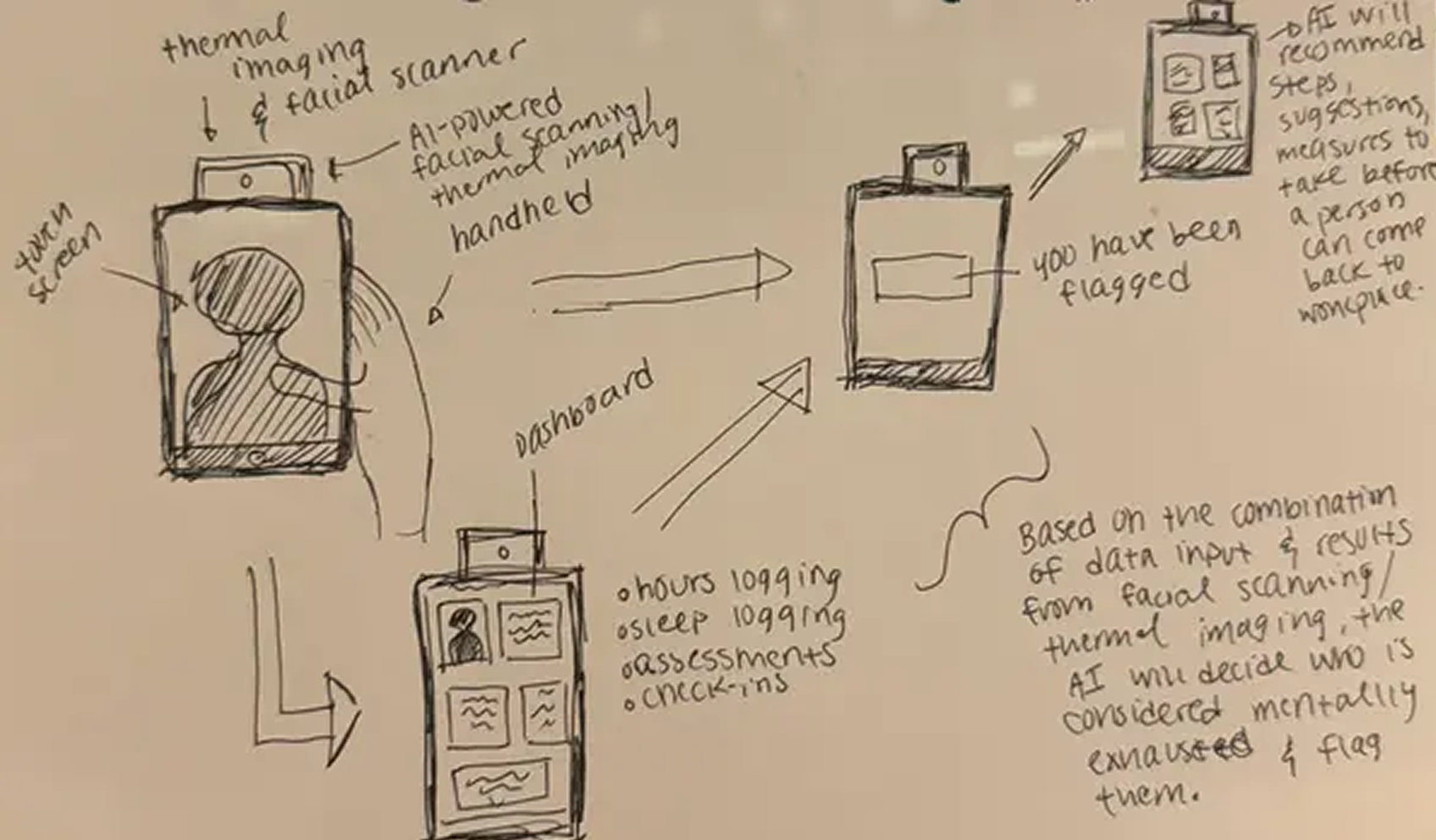
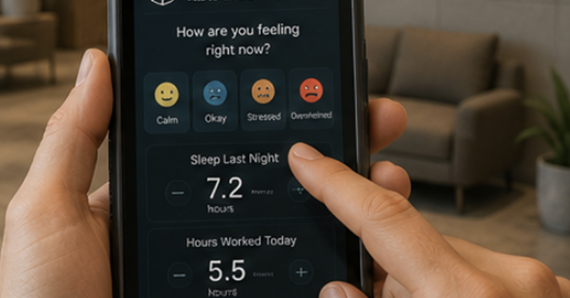
Daily log input + AI facial scanning + thermal imaging → Mindstate AI flags exhaustion and burnout → prompts the user to take action. The mechanism is the hard part.
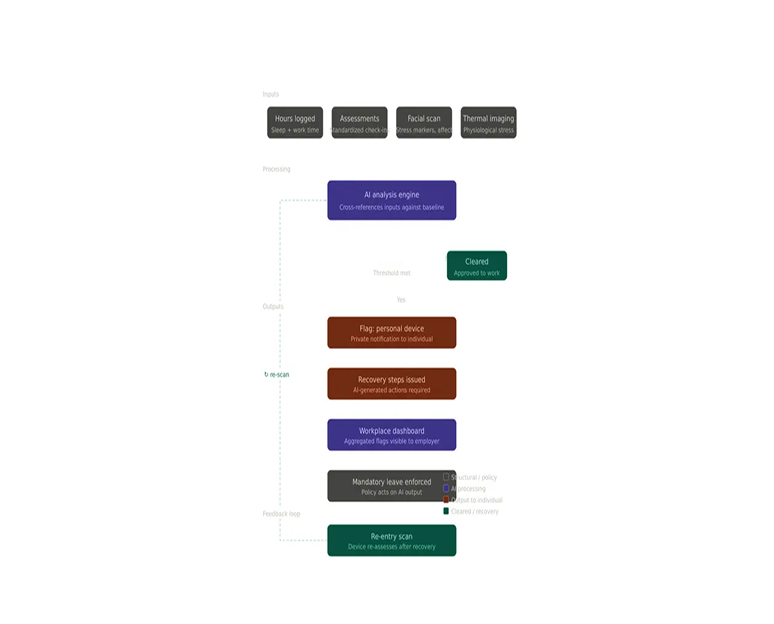
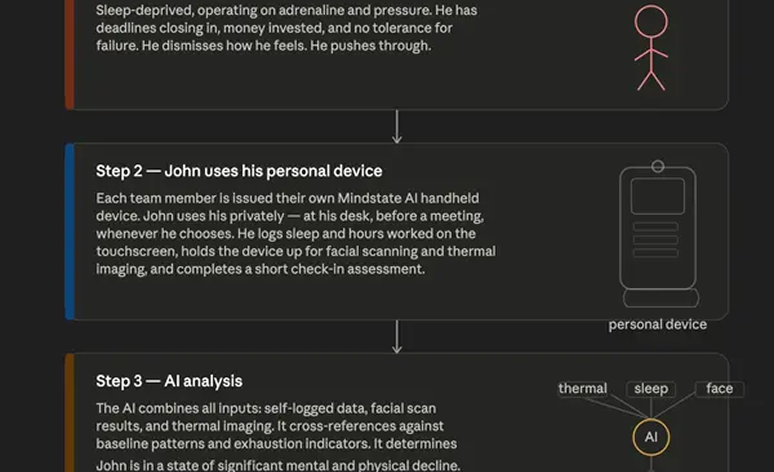
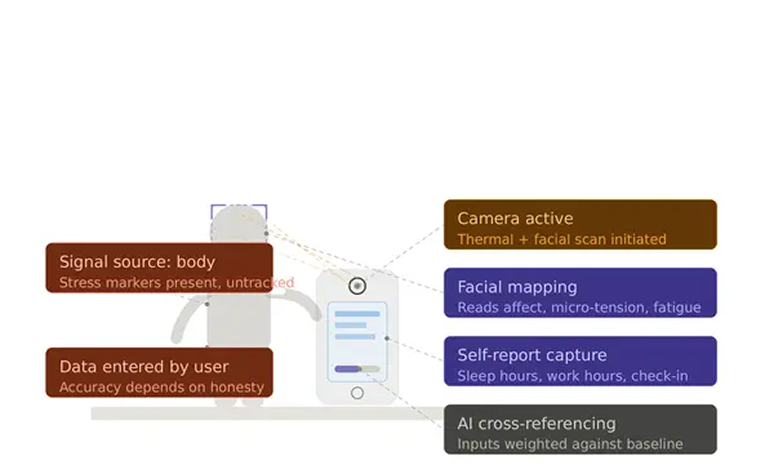
The device works when John doesn't know it's watching. Input is honest because it's routine. The scan is trusted because it's private. The flag is meaningful because John chose the system — nobody forced it on him. That consent is what separates this from surveillance.
The visual world every generated image must belong to. Not a style reference: a set of rules that every generation is measured against.
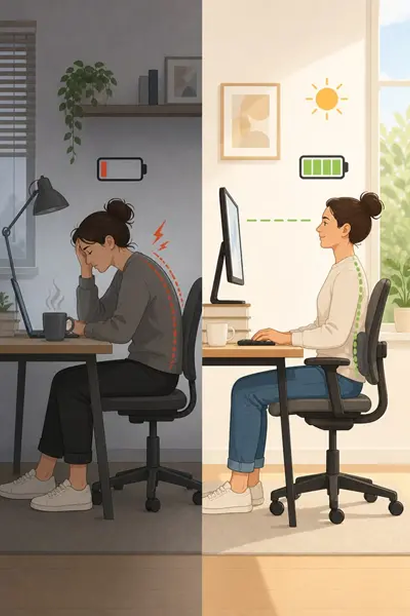
Strongest reference from moodboard
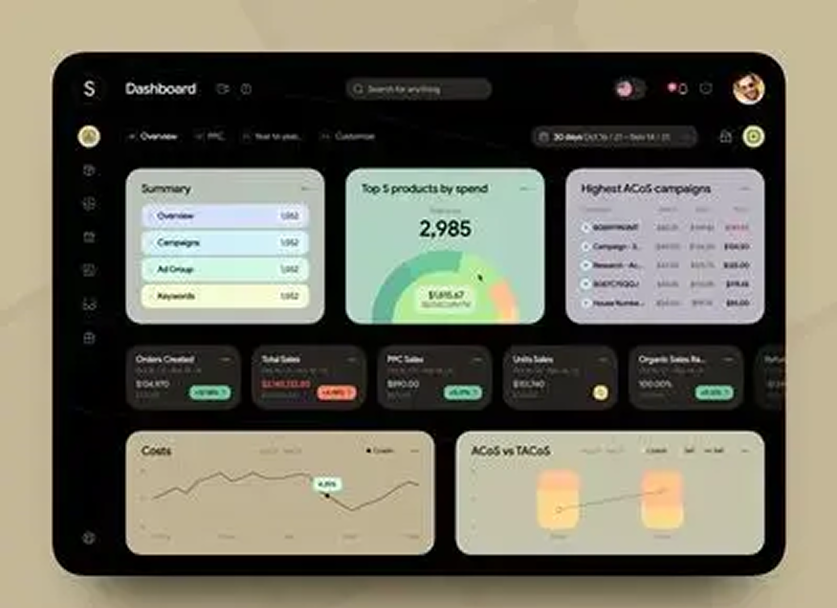
Strongest reference from moodboard
The world this project lives in is clinical but not cold. The device is small, handheld, and serious-looking — like a medical instrument designed by a tech company that still cares about aesthetics. Light is cool and controlled. Environments are professional: desks, meeting rooms, closed offices. The person holding the device looks tired but composed. The emotional register is understated — this is not a product that shouts. Never show a person smiling at the device. Never show a data dashboard that looks like a public scoreboard. The device is private, diagnostic, and quiet about what it knows.
This or That:
12 shots across four groups. What worked: shots that removed the person and let the device lead felt more honest to the concept. What didn't: anything that looked too designed, too clean, too optimistic.
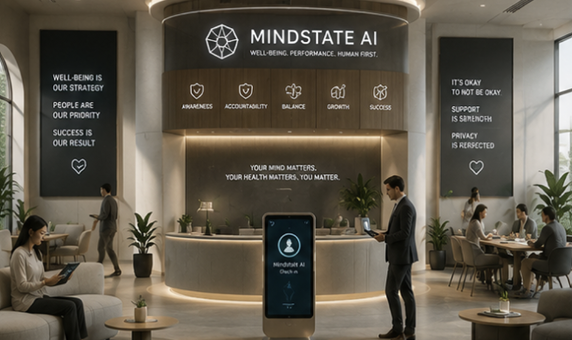
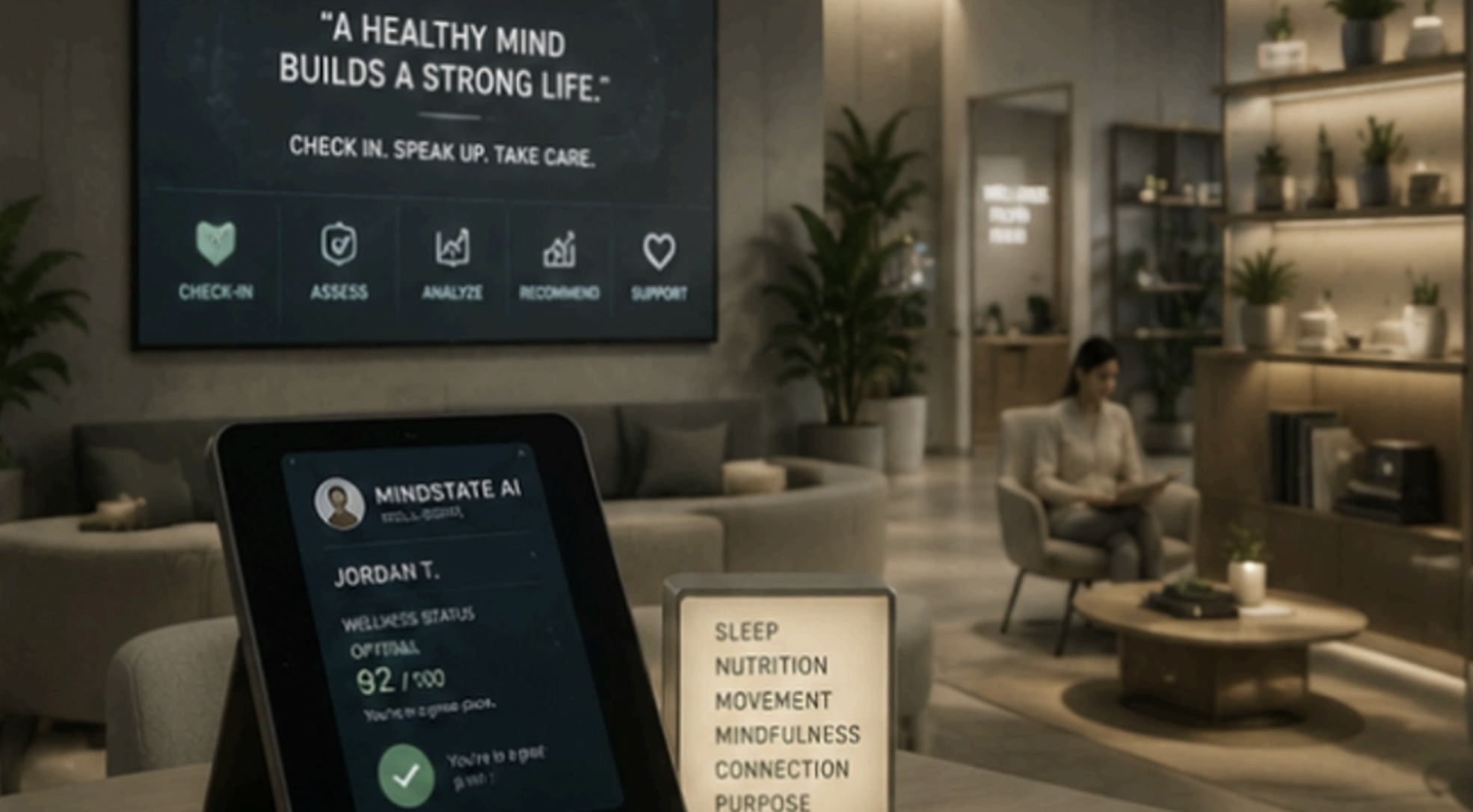
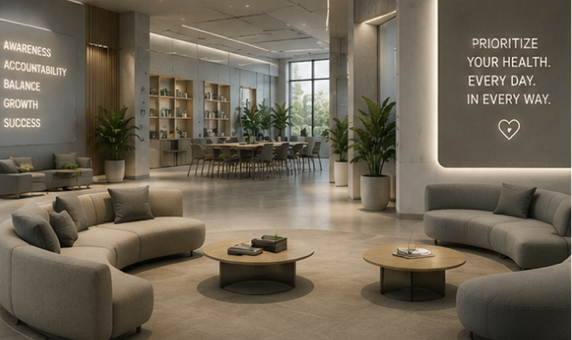
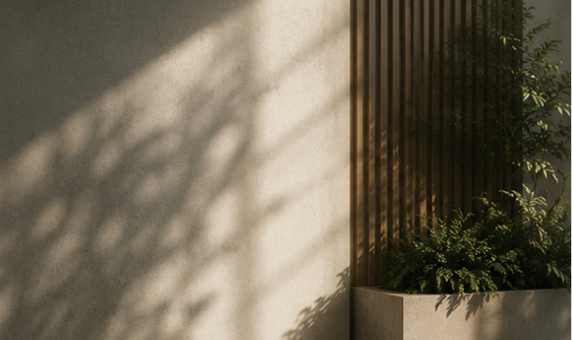



What changed
Providing the AI with one specific seed to develop a set of pictures is an efficient way to ensure the images come from the same world. The loop taught me that the seed isn't just a style guide — it's a constraint that keeps the generation honest.
Storytelling
Four beats. Who John is, the moment his body's signals can no longer be ignored, the device entering the scene, and what still remains open.

John is 32. He is a sleep-deprived businessman. His work is piling and he feels he can't continue much longer. He feels trapped. He is burnt out and exhausted, and he lacks the energy, time, and consideration to focus on his personal well-being. He puts too much pride in his work and refuses to take action to recover.
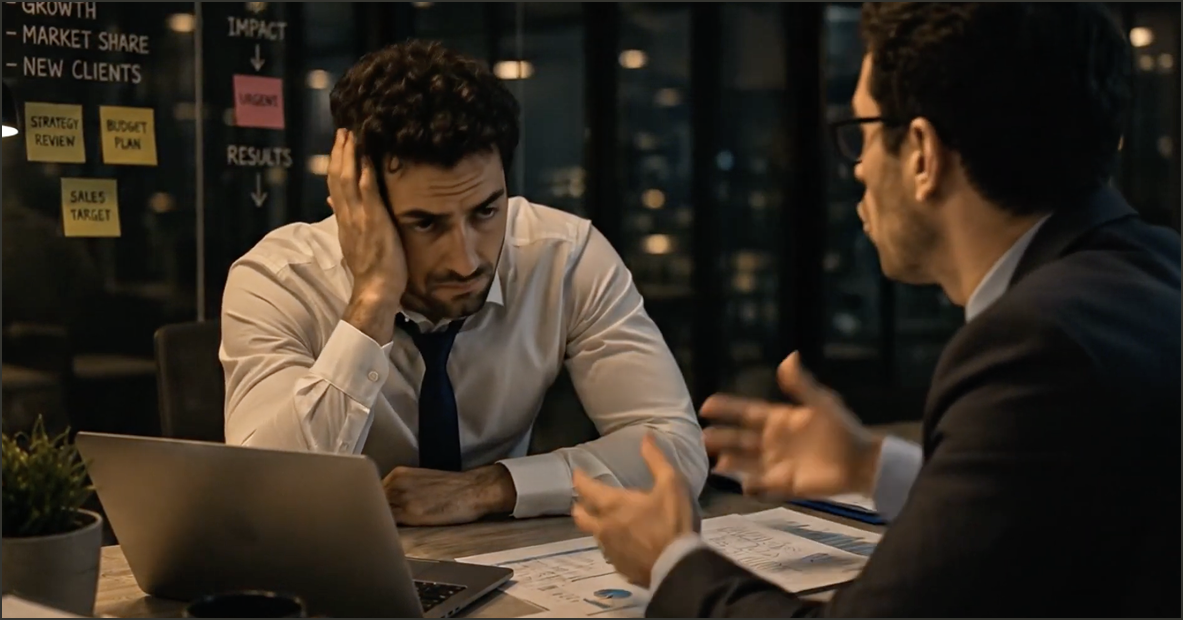
Emotional and physical health are often neglected in the process of chasing success due to pride and fear of being perceived negatively in the workplace. As a result, John can become burnt out and exhausted — a deteriorating mind and body will eventually lead to a decline in quality of work.
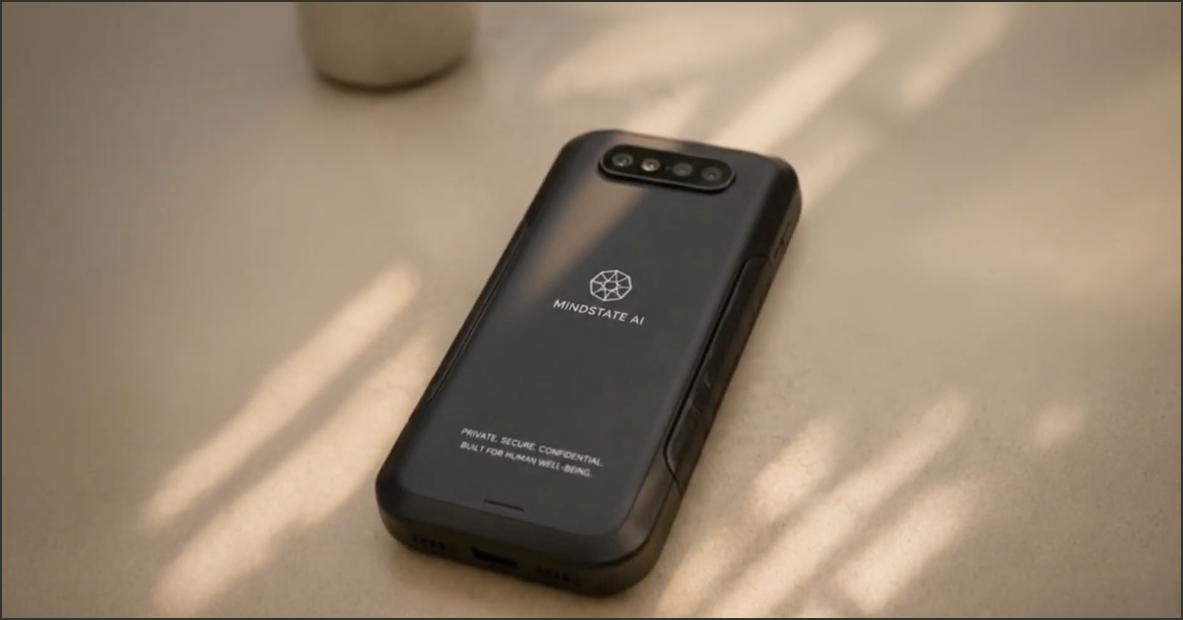
Mindstate AI is a workplace device. Each team member is given a single device. Each individual inputs data daily by logging hours of sleep and hours worked, completing assessments, and using facial scanning and thermal imaging. Based on the input, the device uses an AI flagging system to detect exhaustion and burnout.
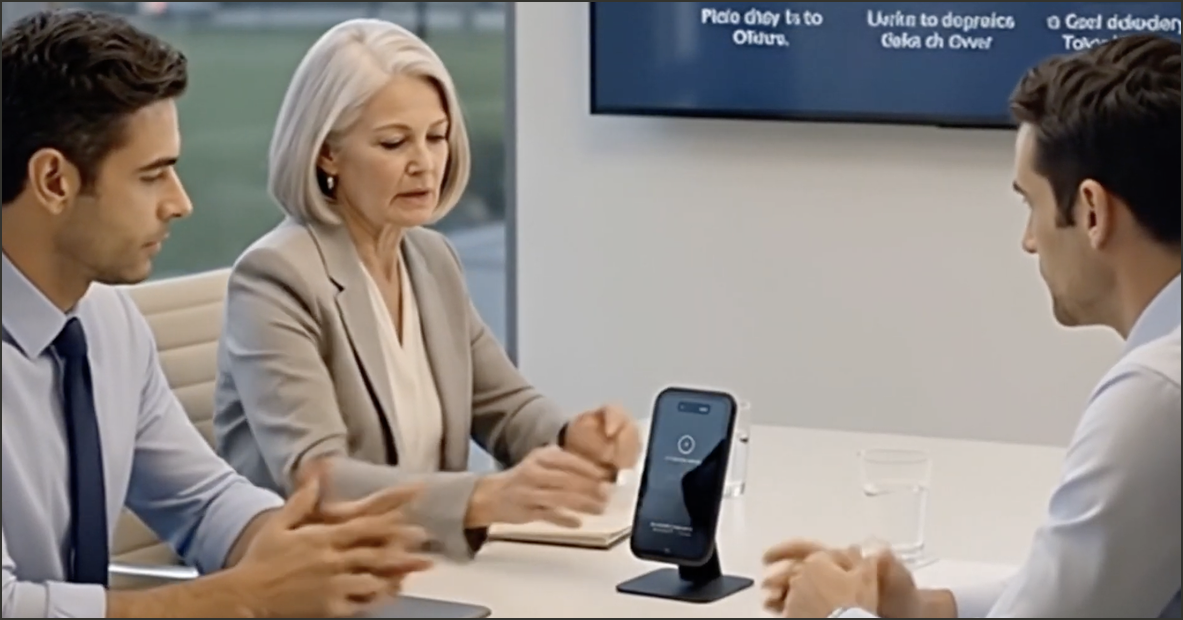
Implementing policy in the workplace is required to use this device. Questions regarding accuracy may arise. Using Mindstate AI requires companies to agree on certain workplace rules and conditions. These remain open.
Building with AI as a thinking partner is a back-and-forth process that required thinking for myself, rather than having the AI do the thinking. Using my vision as a designer and executing, implementing, and enhancing with AI tools allowed me to push outside the boundaries.
What the making taught me
Building with AI as a thinking partner is a back and forth process. It is key to combine the power of the human brain with the power of AI to get the most optimal results. Using my vision as a designer and then executing, implementing, and enhancing with AI tools allowed me to push outside the boundaries and create something I would have never thought of before.
Evaluate
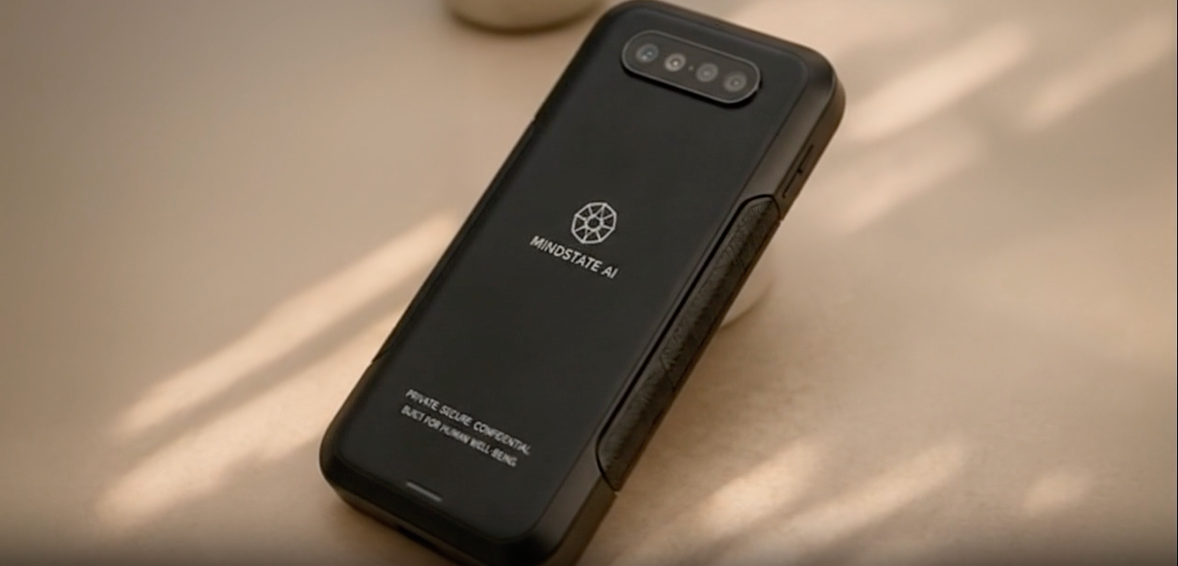
Building with AI as a thinking partner is a back and forth process that required me to think for myself, rather than having the AI do the thinking for me. When working with AI throughout this project, it is key to combine the power of the human brain with the power of AI to get the most optimal results. Using my vision as a designer and executing, implementing, and enhancing with AI tools allowed me to push outside the boundaries and create something that I would have never thought of before.
Working with AI taught me that tailoring the prompts with very specific detail is a crucial part of getting the output I need.
Week 1: Before
When I first encountered AI, ChatGPT had started to become popular. I thought AI was just some online machine that combs the internet to find a specific set of information. I had assumed it was on the same level as Grammarly — a tool for school work. I was shocked to find it could generate images or videos that look so real.
Week 10: Now
Creating something as a designer requires adapting to the various tools that are constantly evolving and changing — such as AI and other technology.
Class Gallery
Not polished — real. Every image here is a decision point or an experiment that shaped what was made.
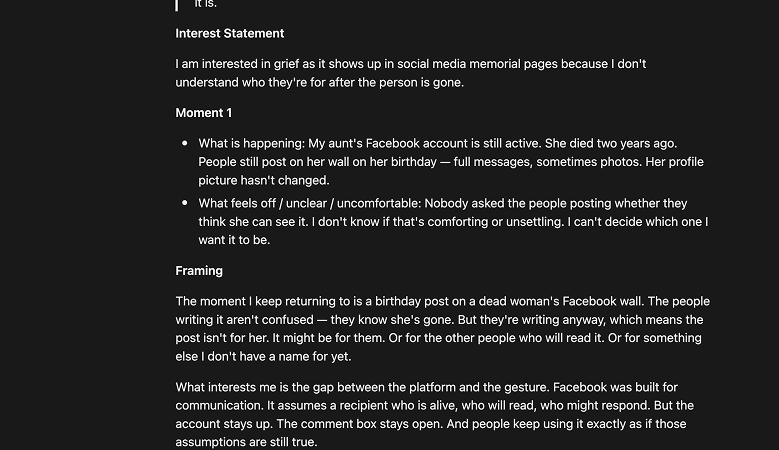
Brainstorming to find the issue — creating a frame requires thinking about real world problems people face in everyday life.
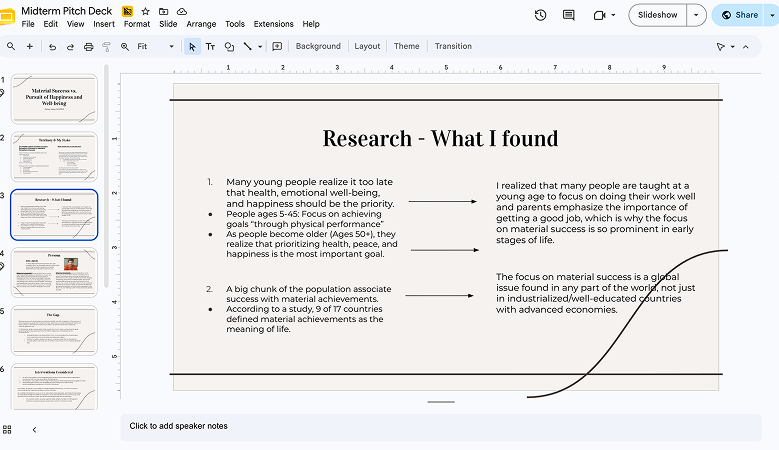
Gathering the research — the researching phase helped understand the problem, allowing formulation of an effective intervention.
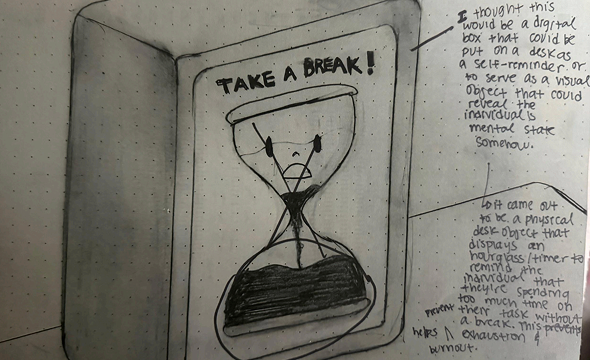
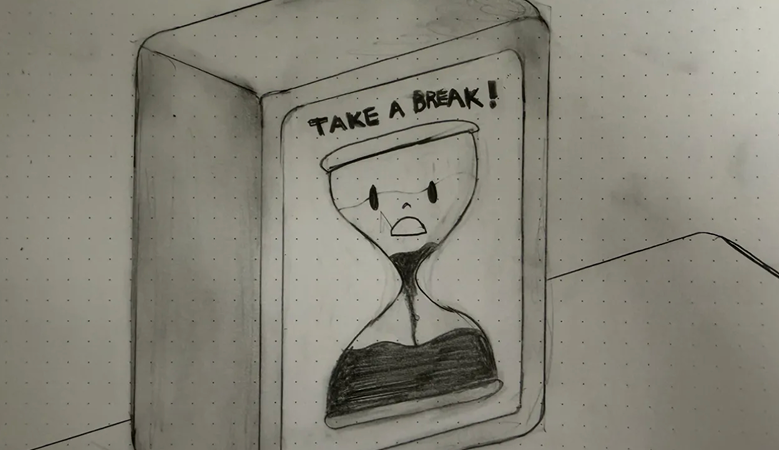
Sketching out the ideas — drawing them out revealed flaws as I thought more about the details.
Bringing ideas to Claude — I noticed flaws in my initial public dashboard idea, and changed the concept to individual devices to allow for user privacy.
Generating design images with AI — providing one specific seed ensures images come from the same world.
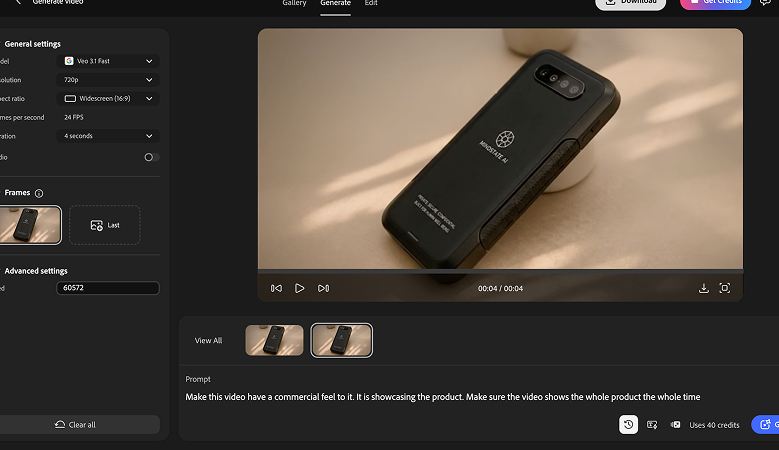
Turning images into video animations — specific prompting is required to get the animations you want.
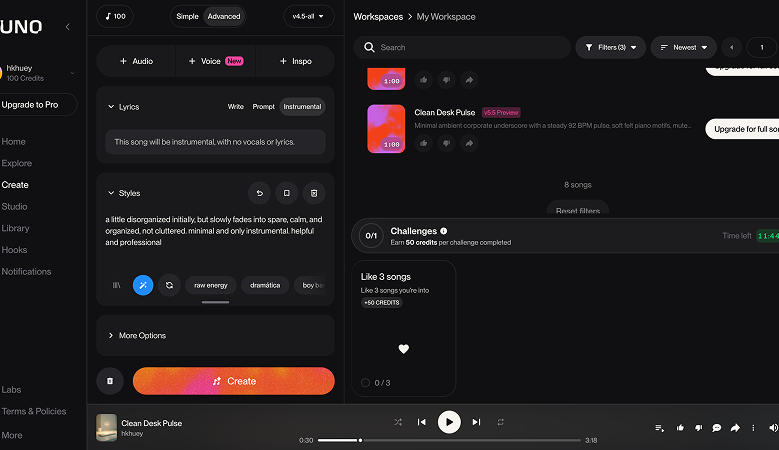
Creating music with AI generation — selecting the music plays a crucial step in conveying the feel of a concept.
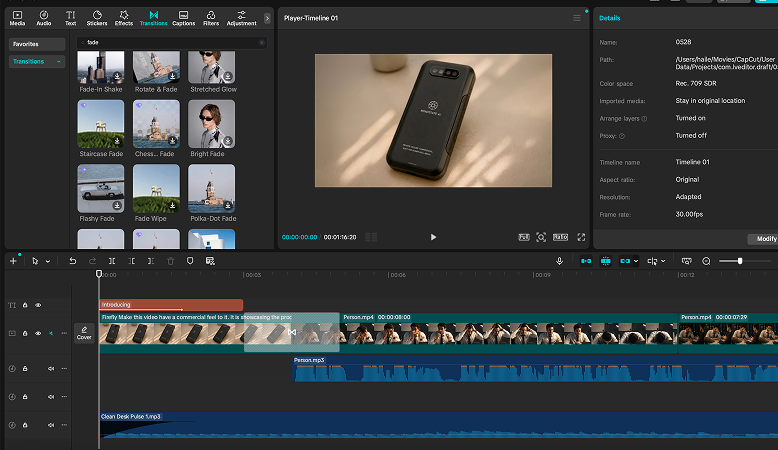
Compiling the video together with audio and music — pacing and intentional pauses are very important to help the viewer follow along.
Final video concept — the dashboard that exposes what John has been ignoring about his own health.