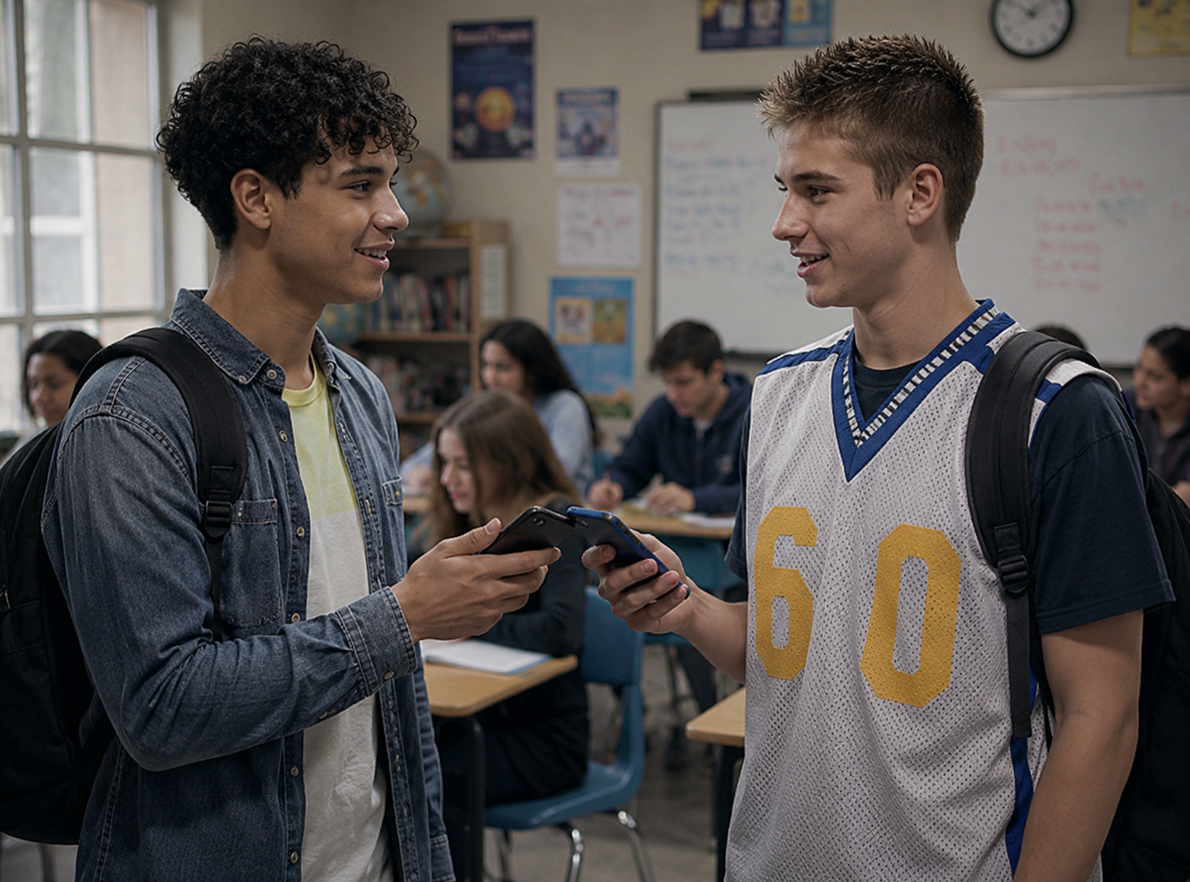
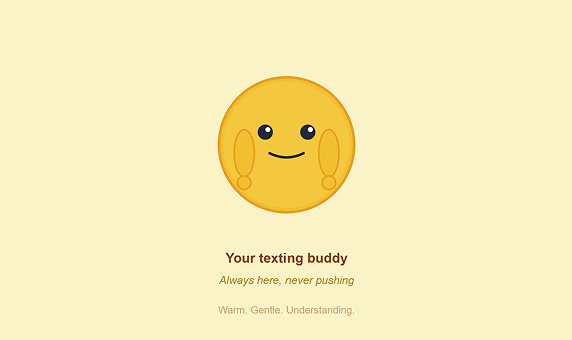
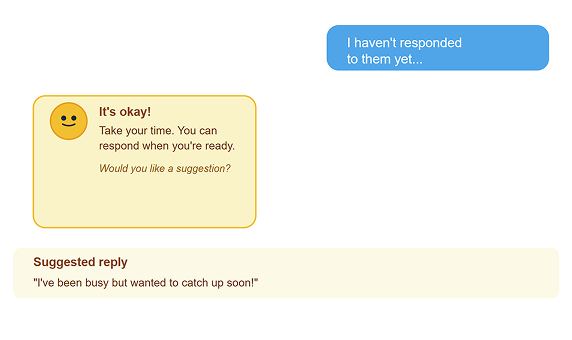
Text-Assist looks at your past texting thread and your calendar to understand the context of your relationship and what is going on in your life at this moment. It suggests a reply. It does not respond for you — it communicates your situation and headspace, to help people understand each other. Text-Assist makes texting easier to build friendships and foster community.
Gather
Before any research, the collaboration was configured. Six levers shaped how Claude would participate — not a blank prompt, but a specific role with specific instructions about how to push back.
Act as a collaborator who notices gaps in my ideas and gives me things to consider or think about or different directions to go in, as well as generating many helpful ideas.
Help me create a very solid idea and a very solid way to execute it. Point out any logical gaps or things I need to think about.
Push me on things I might have not considered in my process.
Communicate clearly and concisely. Do not overexplain.
Never give me unfounded information. Always check that what you are saying is true and correct.
Always return to the idea of how to better texting communication in terms of communicating response time expectations. Keep in mind the character of Daniel.
Your prompt
"Generate 5 directions I haven't considered yet. Make at least two of them feel wrong or uncomfortable to me."
Claude
Okay. Here they are:
1. A preset response-time menu you send before texting someone. "Hey, just so you know — I'm in focused mode, I'll respond in 2–4 hours" sent as a status or auto-message upfront. Preventative, asynchronous.
2. A shared "texting contract" two people fill out together — literally writing down their expectations and sending it back and forth. Ritual, mutual buy-in.
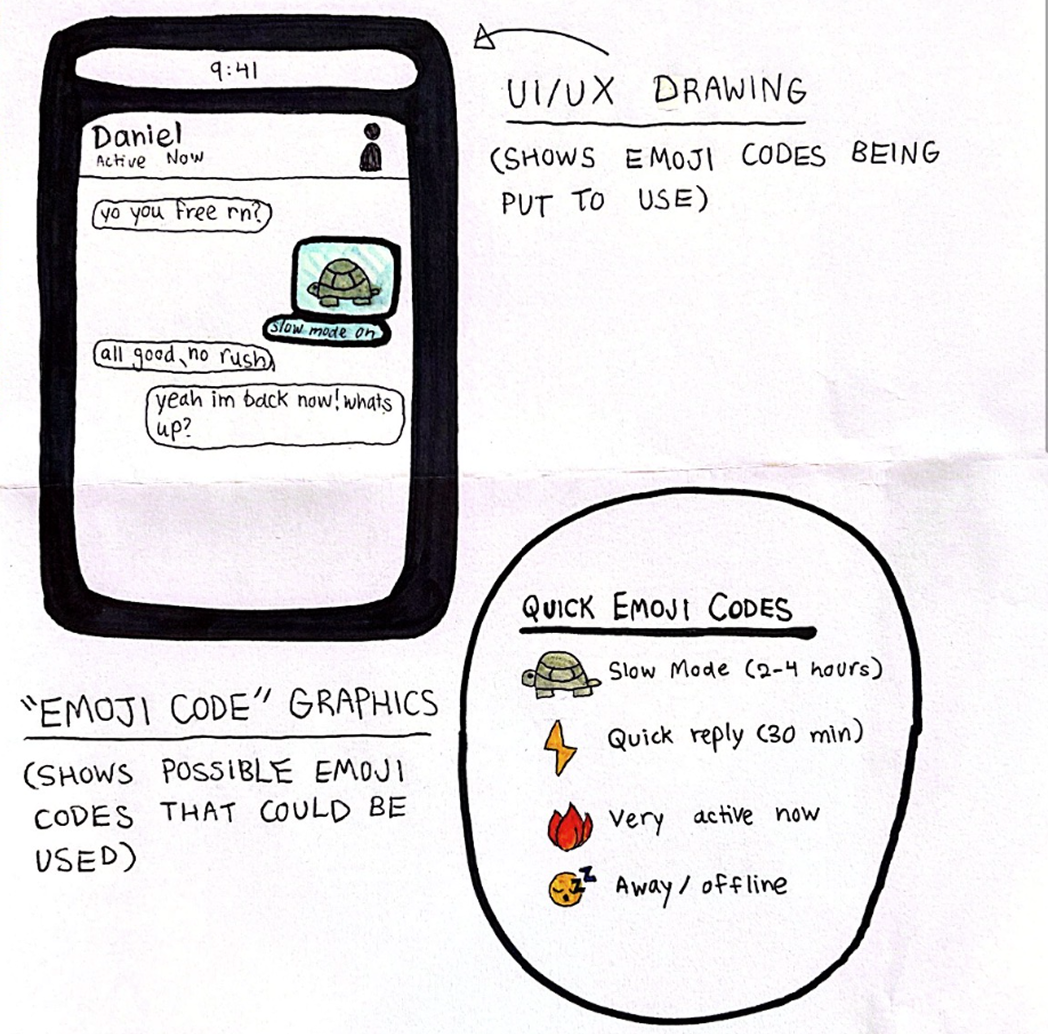
3. A reaction/emoji system that replaces words. Instead of texting "sorry I took so long," you just send a specific emoji that means "I saw this, I'm slow to respond, it's not about you." Nonverbal, removes pressure to explain.
4. An absurdist game or meme format where people publicly roast their own texting habits. "I'm a 3-day responder and I'm sorry" becomes funny, normalized, shared. Humor as permission.
5. A "dead phone" alert system — Daniel proactively texts "I'm offline for 6 hours, don't take it personally." Honest, explicit, removes guessing.
What it changed
This helped me examine more possibilities of what my project might look like that I had not examined before. This helped get me out of my head and into the real world — seeing what options were possible and to dream of the impossible.
What does it mean that a text can go unanswered for three days without either person agreeing that this is acceptable? The research mapped five factors that shape this problem.
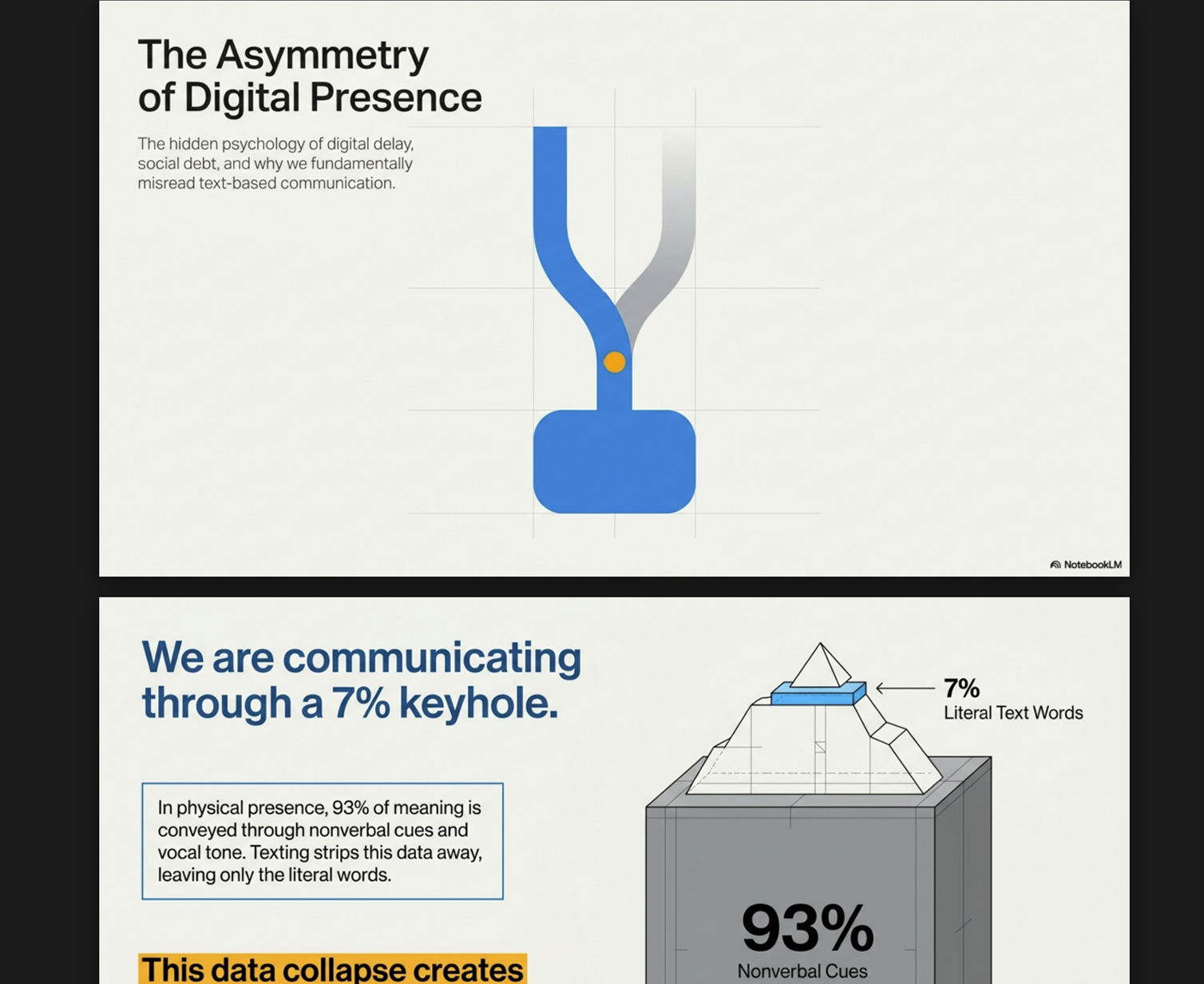
What it revealed
It was very useful to have all of this information combined and referenced across different media. It revealed the commonalities and patterns between the different problems and factors. It changed my question by shifting my focus from how texting works to — now having an understanding of the different challenges and uniqueness of texting — how I can improve texting for a specific situation.
I am interested in helping people communicate and understand each other better as it appears in text messages and the struggle to respond — because communication is the key to community and fostering relationships, but the medium of texting can hinder this from happening.
This is for relationships — friendships, romantic relationships, colleagues. For helping people such as Daniel and Anthony — college students trying to connect and build friendships with their own busy lives and mental struggles.
Explore
Two early sketches showed two different directions. A prompt to Claude revealed the gap between them — and between the problem being described and the solution being designed.

Source 01
How we say no (and don't)
Research on avoidance strategies in communication and the social cost of a delayed or absent reply.

Source 02
The context of the text
How the timing, format, and context of a text message shapes how both parties interpret the exchange.

Source 03
Urgency and response time
Research on how different people calibrate urgency differently across communication channels — and how mismatch creates friction.
Your prompt
"What do you see here? What does this hold that I haven't named yet?"
Claude
I'm looking at two distinct directions — one that's preventative and structural (Idea 2), and one that's reactive and interpretive (Idea 1).
Idea 2 sets expectations upfront through a status menu. It's about Daniel telling Anthony in advance what to expect. Idea 1 does something different — it steps in after the silence has already happened. The emoji codes act as a permission structure to reframe what the silence means.
What strikes me: Idea 1 assumes Daniel is receiving the emoji codes from Anthony. But your sketch shows Daniel using them to interpret Anthony's silence. That's an interesting gap.
So here's what I'm wondering: Which problem are you trying to solve — the anticipatory anxiety (not knowing what to expect before texting), or the interpretive anxiety (what does this silence mean right now)?
What it opened
Claude helped me think more about how there was a disconnect between the problem I was describing and the solution. This opened me up to looking more deeply at what the root of the problem was in the story that I was telling. This made me re-access the solution idea I had made to really make sure it would be the correct answer to helping my people.
Do differences in perceived realness of texting between communication partners increase the likelihood of interpersonal conflict?
There is an opportunity to shift a person trying to make new friends from feeling ignored and lonely to feeling like they have friends and community during text-based conversations, by addressing the difference in expectations during texting.
How might we help college students communicate over text in a way that prevents misunderstanding and hurt feelings over texting response times?
How might we create an app or extension that allows friends texting to communicate the urgency and expectation behind a sent text message?
How might we design a way to communicate between people that meets peoples' need to make plans while alleviating the emotional baggage tied to one's perceptions of friendship and loneliness?
Narrow
The person: a college student trying to make plans with friends over text. The problem: differences in texting response-time etiquette cause hurt feelings. The design had to hold both people.
18 · First-year · Venezuelan · ESL
Daniel is a 18 year old student in his first year of college. He is kind, but he can be anxious and is quick to worry. Daniel wants to make friends in college but worries about how others perceive him.
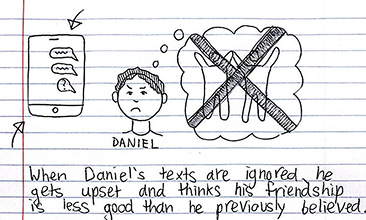
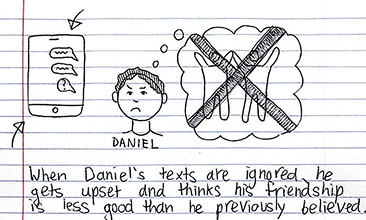
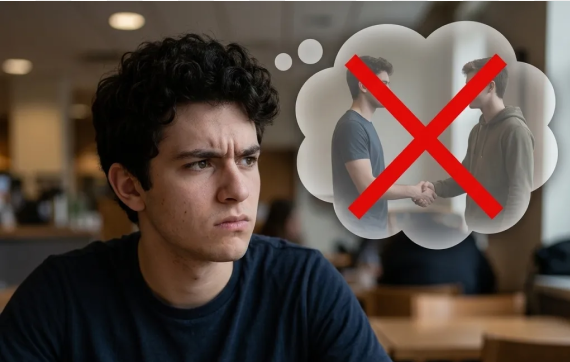
When communicating with new friends over text, Daniel struggles with feeling hurt when people take a long time to respond to his texts. He reads into delays. He is quick to assume the worst.
Athlete · Social · Overwhelmed
Anthony is friendly and social. He plays many sports, and sometimes feels busy and overwhelmed with how much he has to do to balance school, sports, and his social life.
He receives Daniel's text on his way home from back-to-back practices. He technically has time to respond, but his social battery is drained. He thinks, "I will respond later." But he keeps putting it off.
The midterm intervention was a sticker system — a widget for the texting app that allowed texters to express how urgent a text is in a humorous, low-pressure way. The idea was to use AI to create the images, and to come up with what images were needed.
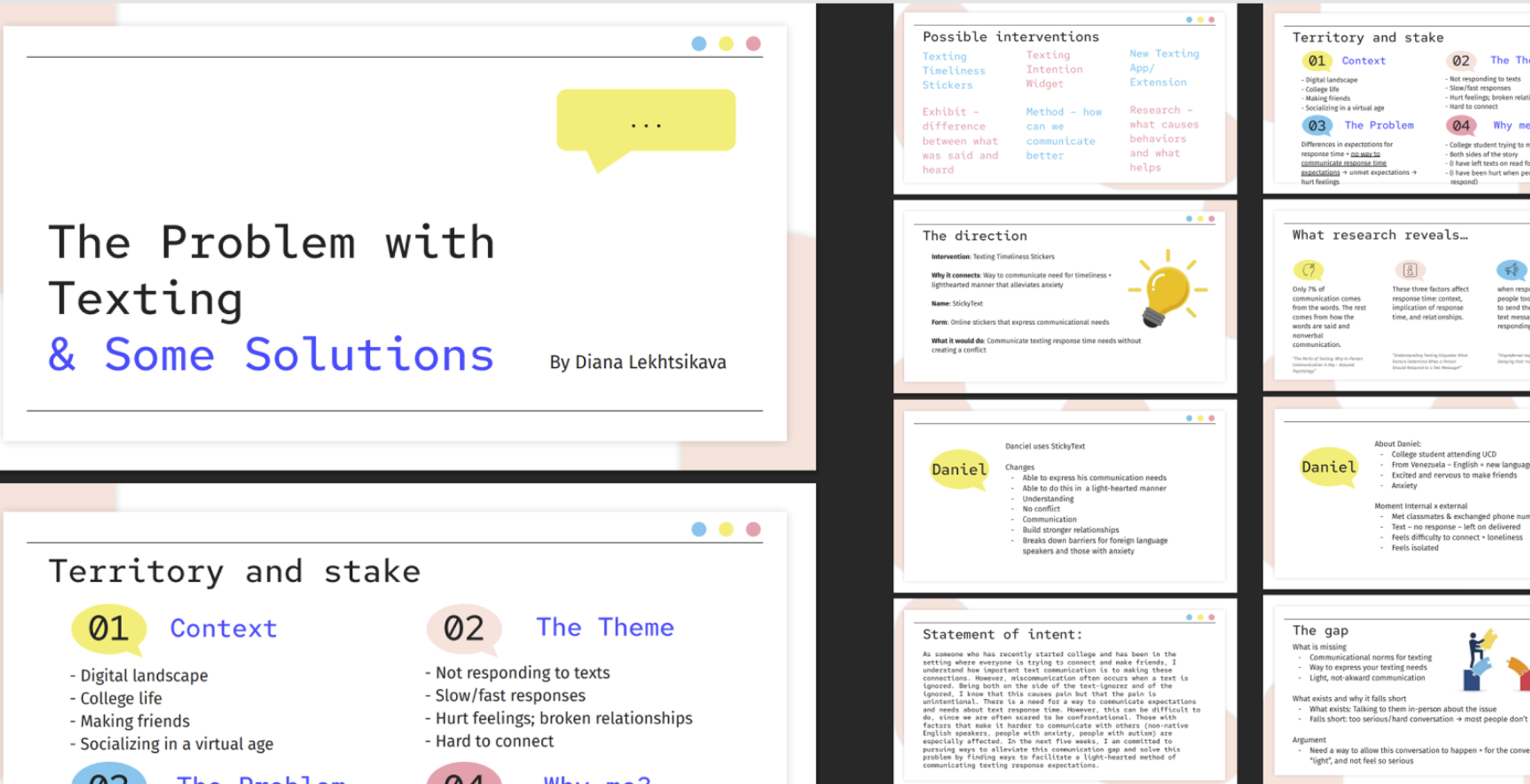
Class Feedback
While this was a cute idea, it did not reach the root of the problem. If somebody is not going to respond to a text, they are not likely to respond with a sticker either.
What shifted
Before the presentation, the focus was on "StickyText" — a sticker system to communicate availability. The class pointed out that while it was a cute idea, it did not address the actual difficulty: if somebody is not going to respond to a text, they are not likely to respond with a sticker either. This led back to basics — to thinking about how to actually address the difficulty of responding, the mental burden and tiredness of it.
All the possible ways to address the problem, mapped out in collaboration with classmates.
Implement
The first generation loop. These images came out of the first session of image generation, before the solution had fully resolved. They show the search: what does a texting reminder look like? What does it feel like?
Export paragraph
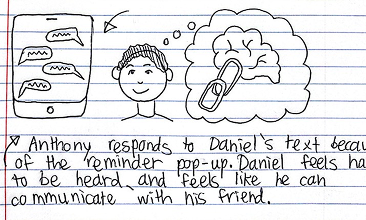
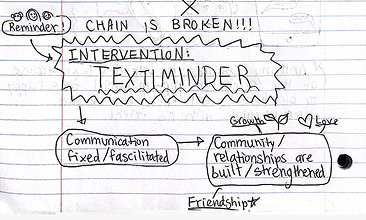
This image generated by Ideogram is the closest output to what I am reaching for. This captures the reminder system for texting and shows how this leads to the emotional and interpersonal results of better friendship and preventing hurt feelings. What changed between A and B is that I defined a direction. I am beginning to form a story and a connection between the element of texting reminders and relationships and feelings.
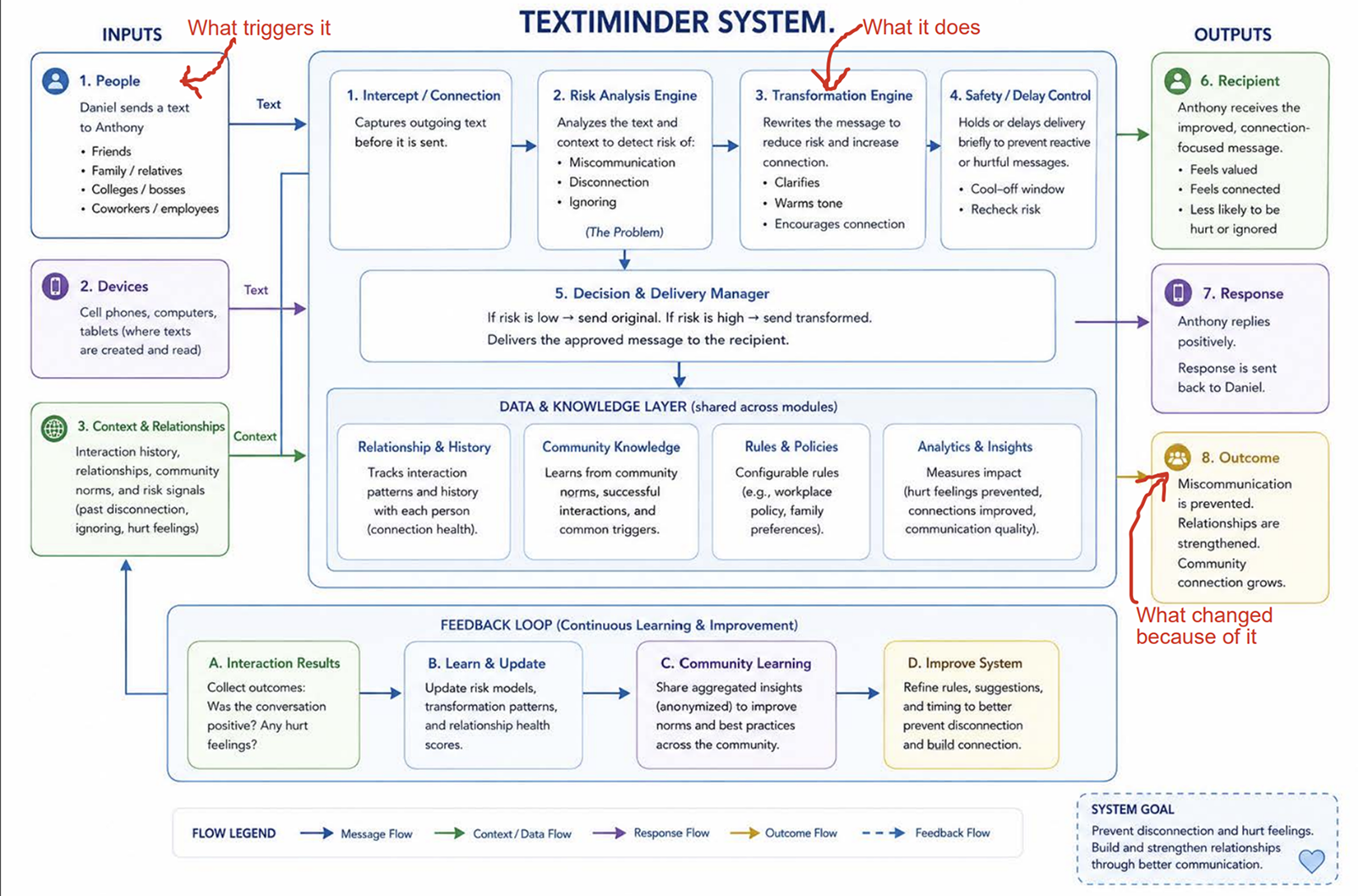
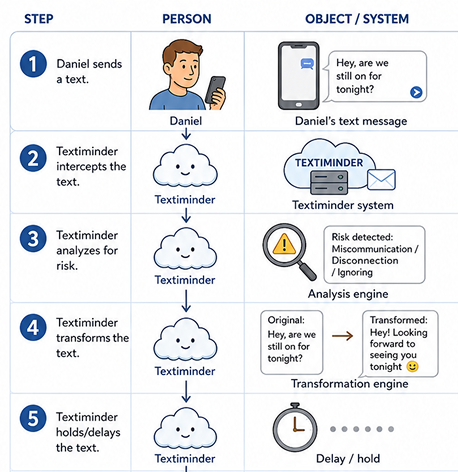
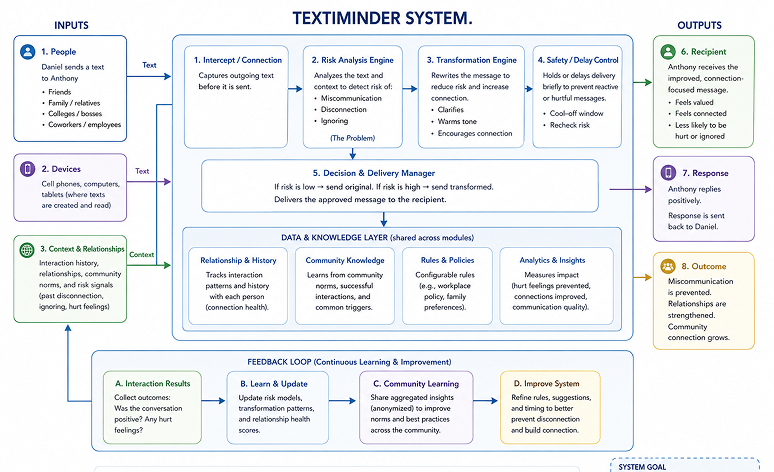
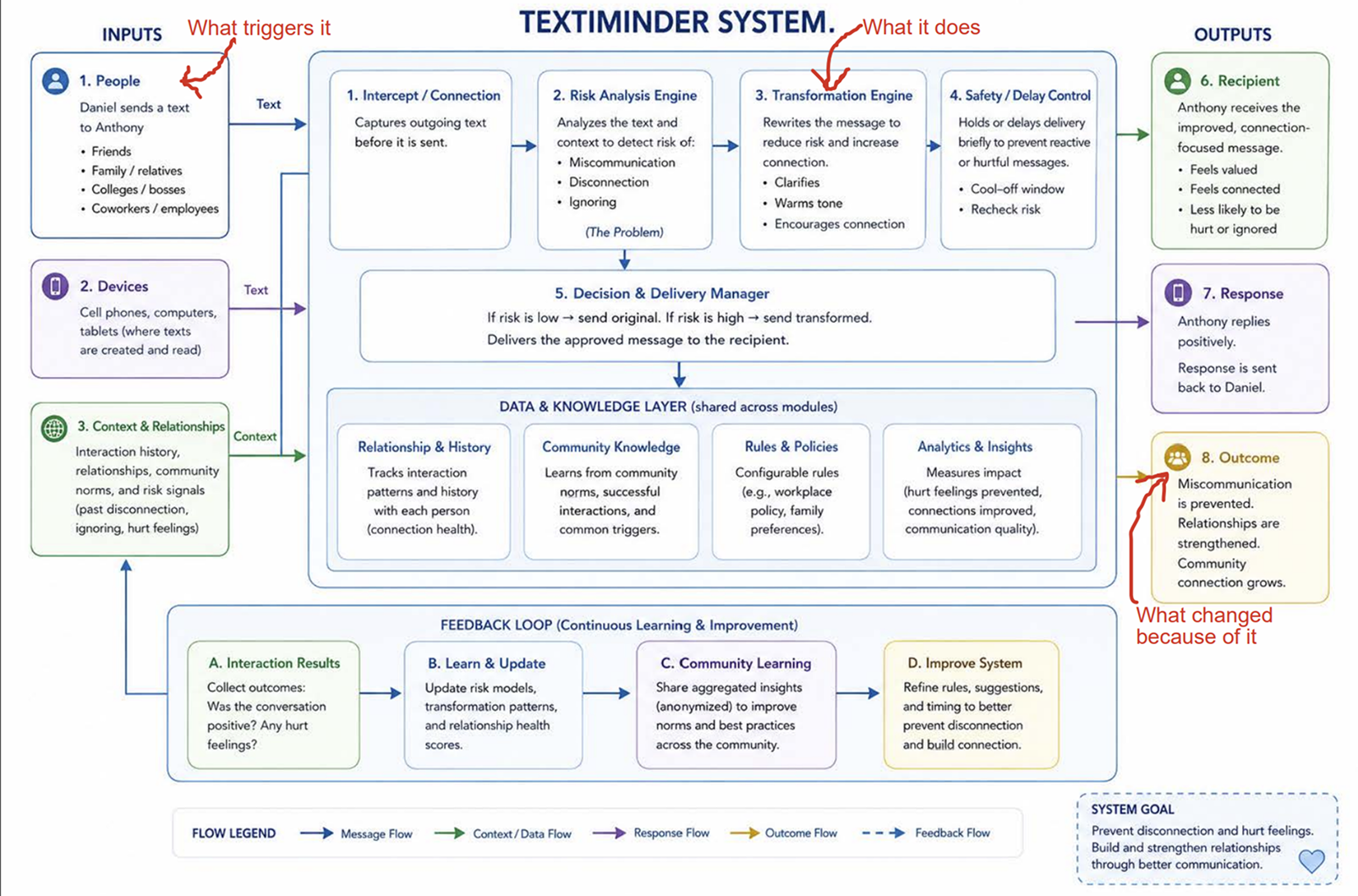
The second loop shifted from aesthetics to mechanism. What is the step-by-step logic of the intervention? A hand-drawn sketch became the prompt.
Your prompt
"This is a hand-drawn sketch of how Textiminder works. Generate a step-by-step visual sequence showing what happens from the moment Daniel's text occurs to the moment Anthony's response text is reached. Show the person, the object, and the change at each step. Focus on the logic of the interaction, not the visual style."
Claude
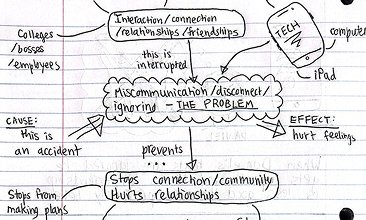
I'm looking at your research map, and I can see the core logic clearly: a broken chain of communication gets mended by Textiminder stepping in at a specific moment.
Before I visualize this, I need to ground it in your actual research. You've identified the problem and named the intervention. But I'm noticing something: who exactly is this sequence for?
Are you mapping this to help Daniel understand what happens when he sends that interrupted text? To help Anthony understand what he's receiving? To help a future user understand how the tool works? Or to clarify the logic for yourself as you're designing?
The sequence will be different depending on whose perspective and understanding you're trying to build.
What you agreed with / disagreed with
I agreed with the fact that my idea at the time was not addressing the correct problem. I needed to choose a direction — am I addressing Daniel or Anthony's side of the issue? What is actually the way to get them to communicate? I disagreed with the idea that this could apply to a future user. I wanted to focus on Daniel and Anthony.
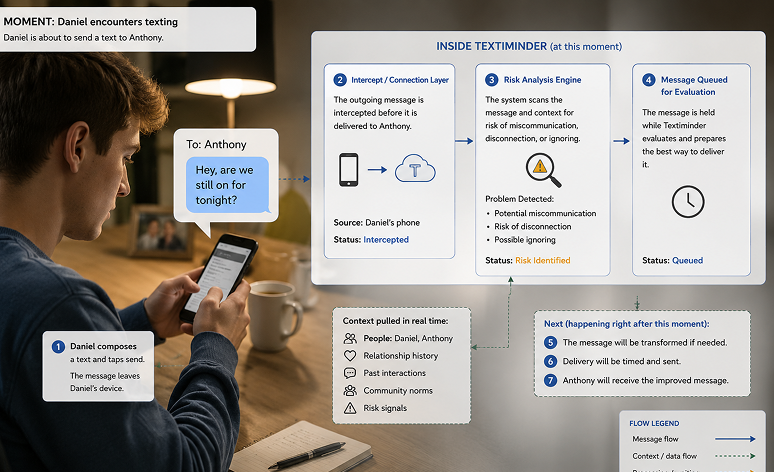
When Daniel and Anthony are in a moment when Anthony finds it hard to text Daniel back, Text-Assist produces a suggested text response because it understands the context by looking at the text thread and at Anthony's calendar. My intervention understands context, like nothing else does. It offers a solution that is personalized and real.
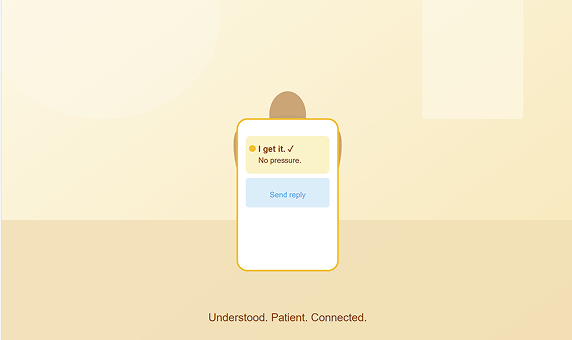
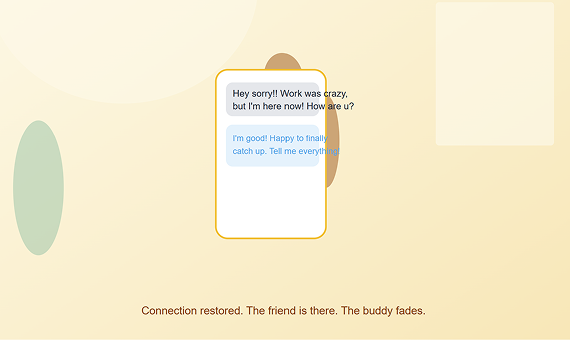
Exploring compositional directions for the app's opening image — portrait and square crops before landing on the landscape version shown above.
Communication-assistance. Community-building. Pressure-reducing.
"Remember to respond when you have time!"
"You have to respond or else you are a bad friend!"
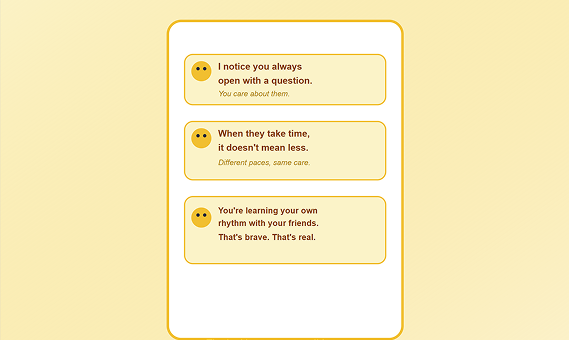
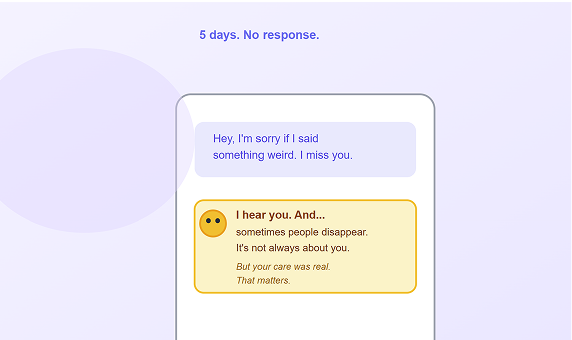
This world is warm, bright, and lit. There is a feeling of closeness and genuine rawness. There is the presence of an AI "texting buddy." This understands the context and history of your relationship through your text history, suggesting helpful replies. This feels unintrusive, helpful, comfortable. The scene is at ease. There is closeness and privacy — emotional closeness caught and brought forward. There is a focus on the friendship, the relationship. We never feel intruded upon, pressured, stressed. Everything in the frame is pleasant and focused on reducing pressure and genuine connection.
Seed paragraph — the brief for every image generation pass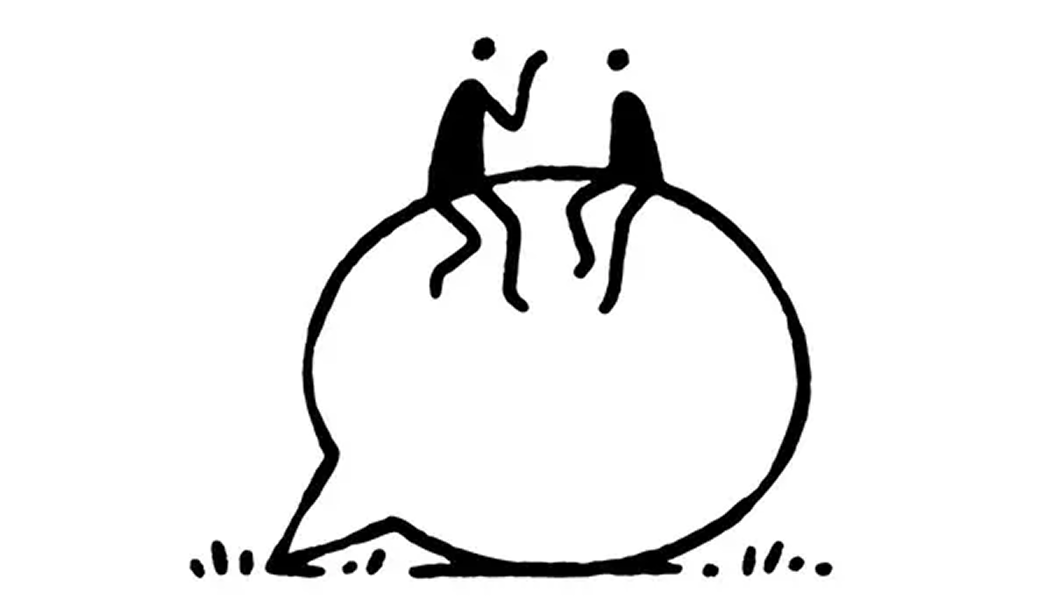
Twelve outputs against the same brief. What worked: generating images that conveyed the right tone. What didn't: strange abstractions that did not succeed in capturing actual objects. What changed: shifting toward ChatGPT for specific imagery and using Claude for brainstorming and ideation.

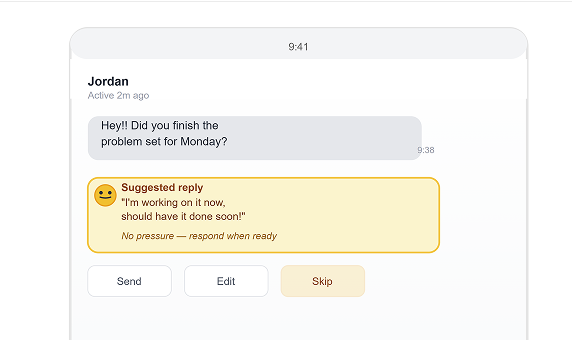

A question of who Anthony and Daniel were and how much their individual characters mattered to the design.
To really define who they were, their personalities, and their life circumstances. Both college students. Daniel is 18, kind, anxious, wants friends but worries about how others perceive him. Anthony is friendly, social, plays many sports, sometimes feels overwhelmed.
These details are what makes it real. These details are the reasons why — in real life — people might find it hard to respond to text messages. It is about the complicated contexts in our lives when we are busy, tired, worried about how people will perceive us.
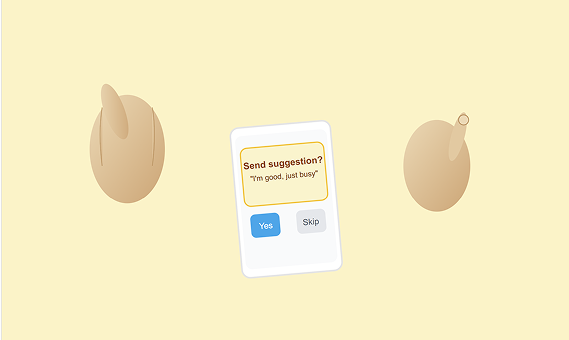
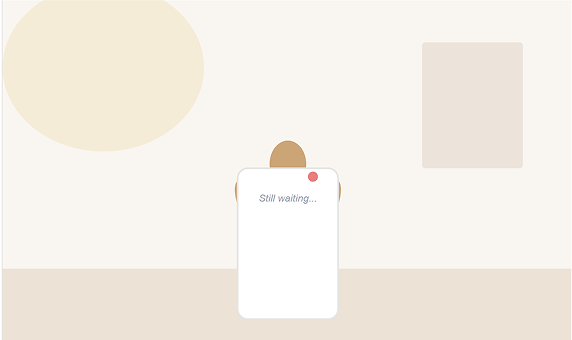
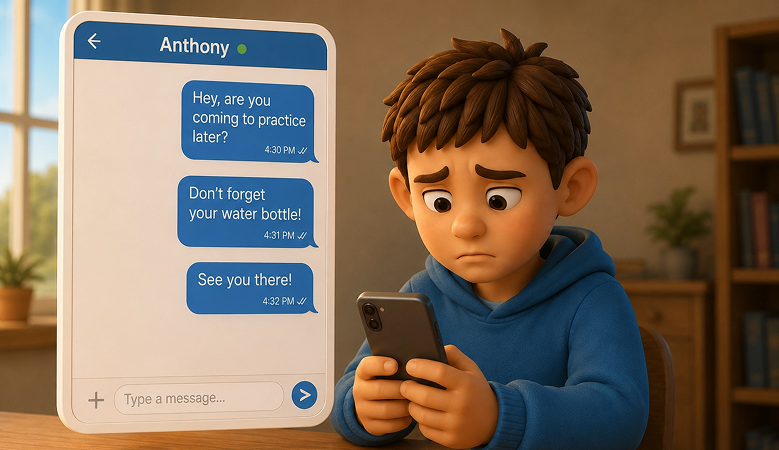
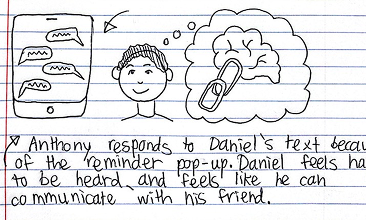
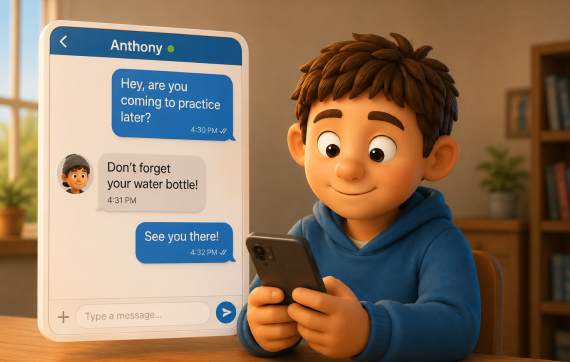
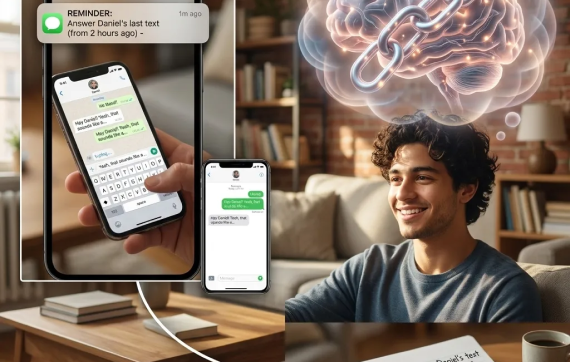
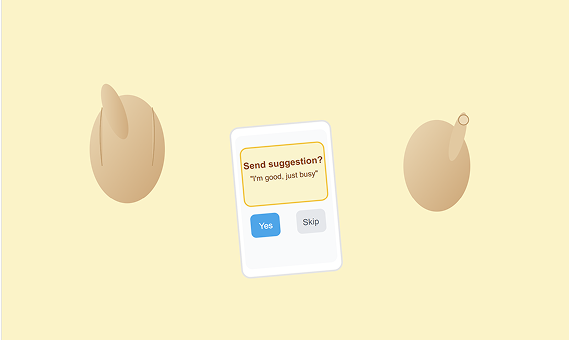
The unanswered thread. Then: Text-Assist activates, reads the context, suggests a reply. Anthony doesn't need to think of a reply himself — he just needs to approve the message to be sent.
Before

After

The suggestion
"Hey Daniel! I just got out of practice and am so beat! Could I get back to you tomorrow?" — Anthony does not need to think of a reply himself. He just approves. Even with a drained social battery, he can communicate his situation to Daniel in the moment.
Storytelling
The video tells the story. I chose a register which is like a social media advertisement and technical explanation while exploring complex emotions and appealing to real feelings. I want to leave the viewer feeling heard, impressed, interested in the idea of Text-Assist, and like there is a solution to their problem.
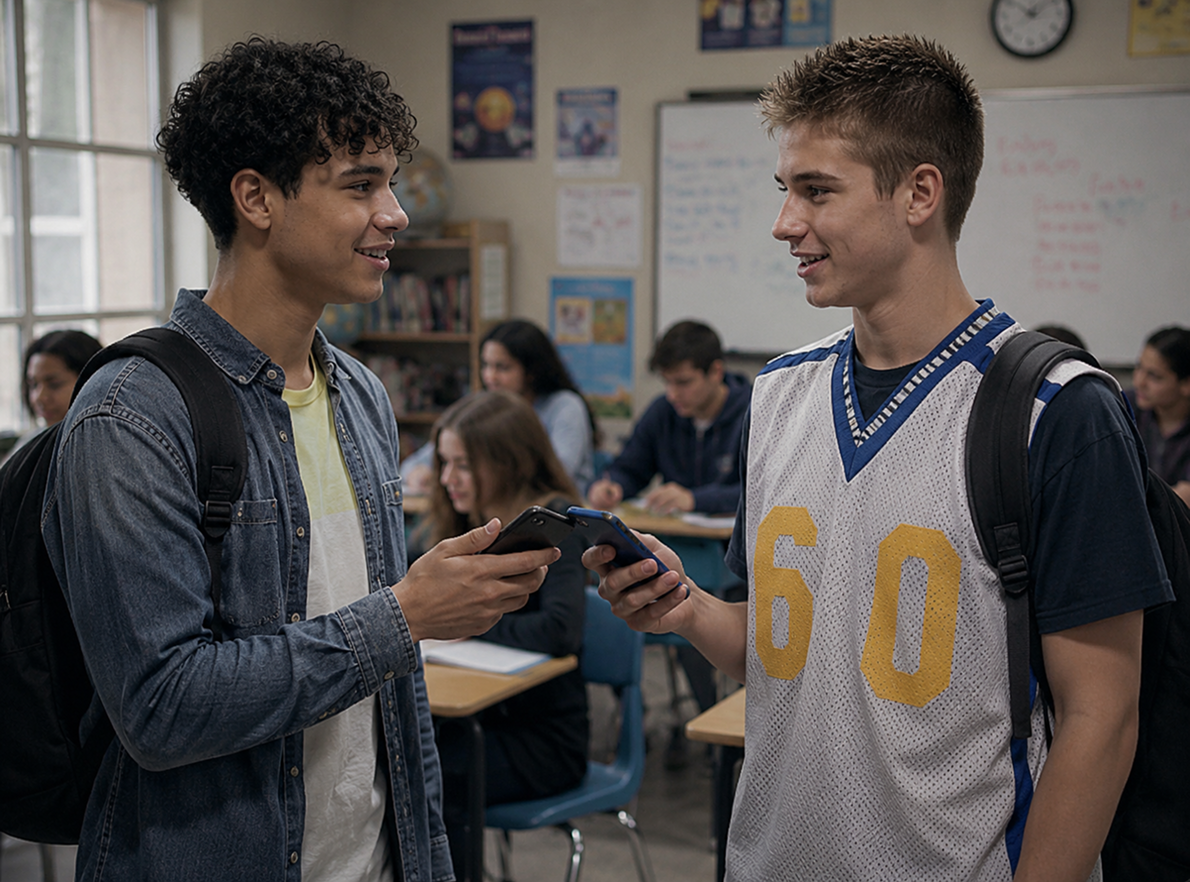
Daniel and Anthony are college students who are new friends. They text to communicate and to make plans. They met in class, exchanged numbers, said they should hang out.
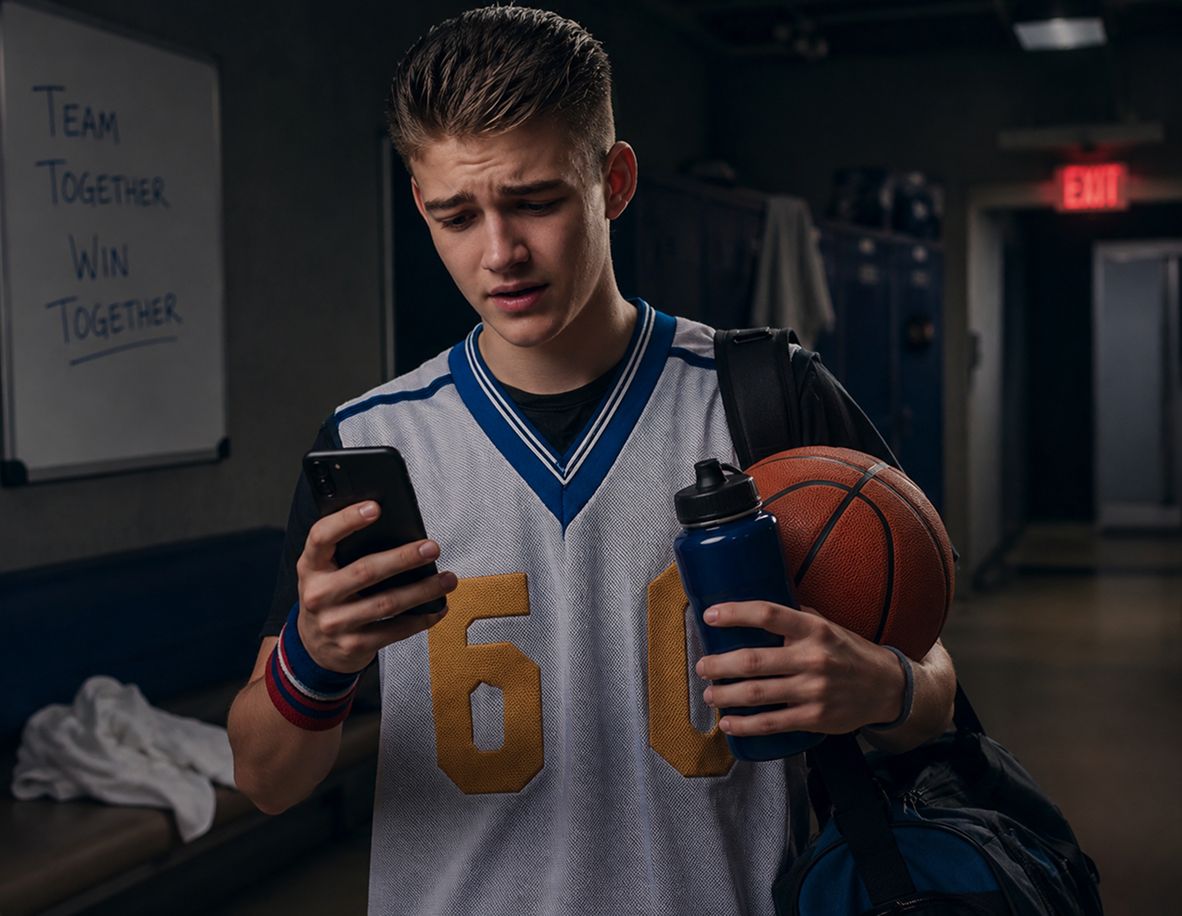
Daniel is often frustrated when Anthony does not respond for days at a time. This causes friction in their relationship, which is hard to address. Anthony is overwhelmed. Both want the friendship. The medium gets in the way.
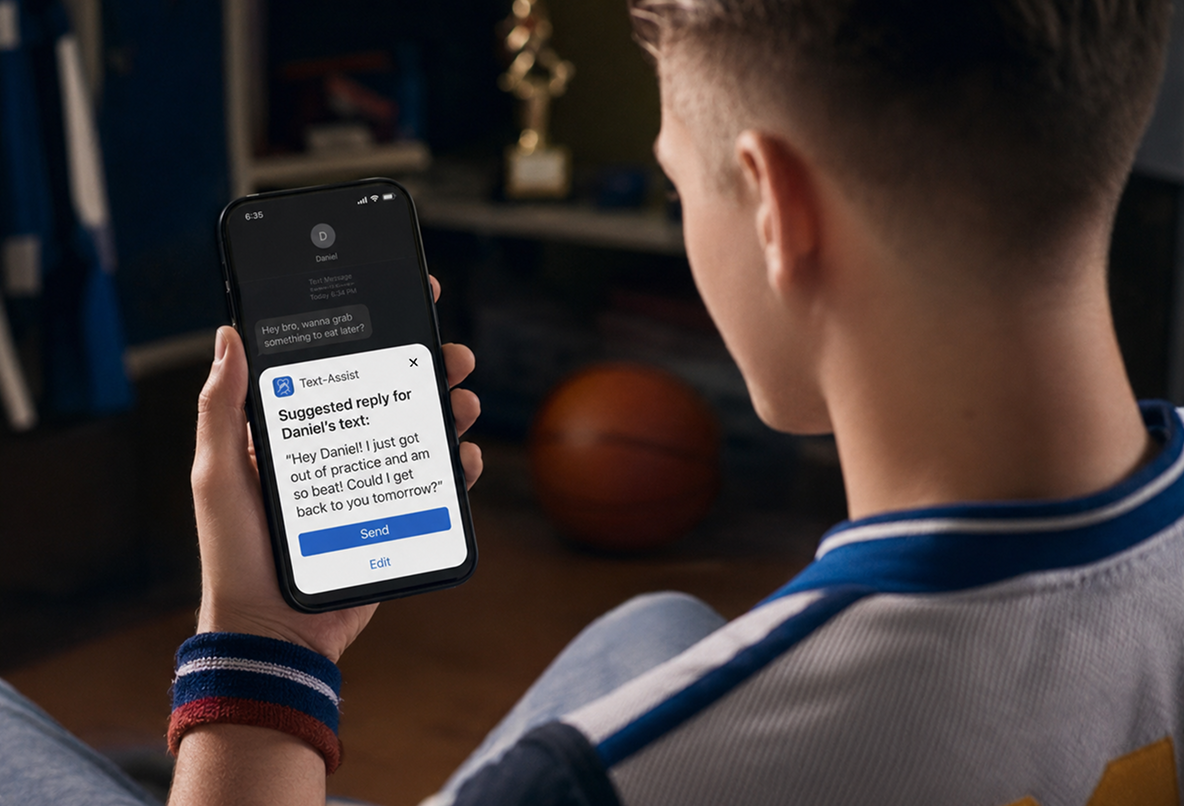
Text-Assist sees the past conversations and sees in Anthony's schedule that he just left practice. When Anthony does not respond for a few minutes, Text-Assist activates. It suggests: "Hey Daniel! I just got out of practice and am so beat! Could I get back to you tomorrow?"

What remains is whether Anthony will reach out to Daniel after the gym. Text-Assist does not communicate for Anthony — that would not be genuine. It helps foster their communication, but what they will say is up to them.
Clear and real. Appealing to genuine feelings about friendship, busyness, and the gap between wanting to connect and actually doing it.
Evaluate

Building with AI as a thinking partner was as follows: I was putting in inputs into the AI — not to get outputs — but to get new inputs to work with myself and to consider for myself to see whether and how they fit into my work. I was both the initial spark behind each idea that used AI. And I was the final filter to decide what my project needs and which direction to take it.
I know the complicated nature of texting, how an individual's real life circumstances are important to consider in making a project, and how to create a project and idea that actually addresses an issue — not just one that covers up the problem.
Week 1: Before
The first time I encountered AI was in high school, when I first saw my classmates using ChatGPT to write essays for class. Seeing my classmates use AI to cheat on homework assignments made me feel negatively about AI. I assumed that using AI is often tied to cheating or taking shortcuts. The ways I saw it being used were limited and it seemed like a "sneaky" tool — not to help in the process of writing, but to replace your own writing and offload the work to a machine.
Week 10: Now
Now I know ways to use AI as a thinking companion. I know how it applies to my question of texting responses. I know why it is hard and a potential solution. I know how it is real and how real life factors get in the way and how addressing such an issue takes understanding a real person — like Daniel and Anthony.
Gallery
Not polished — real. Every image here is a decision point or an experiment that shaped what was made.
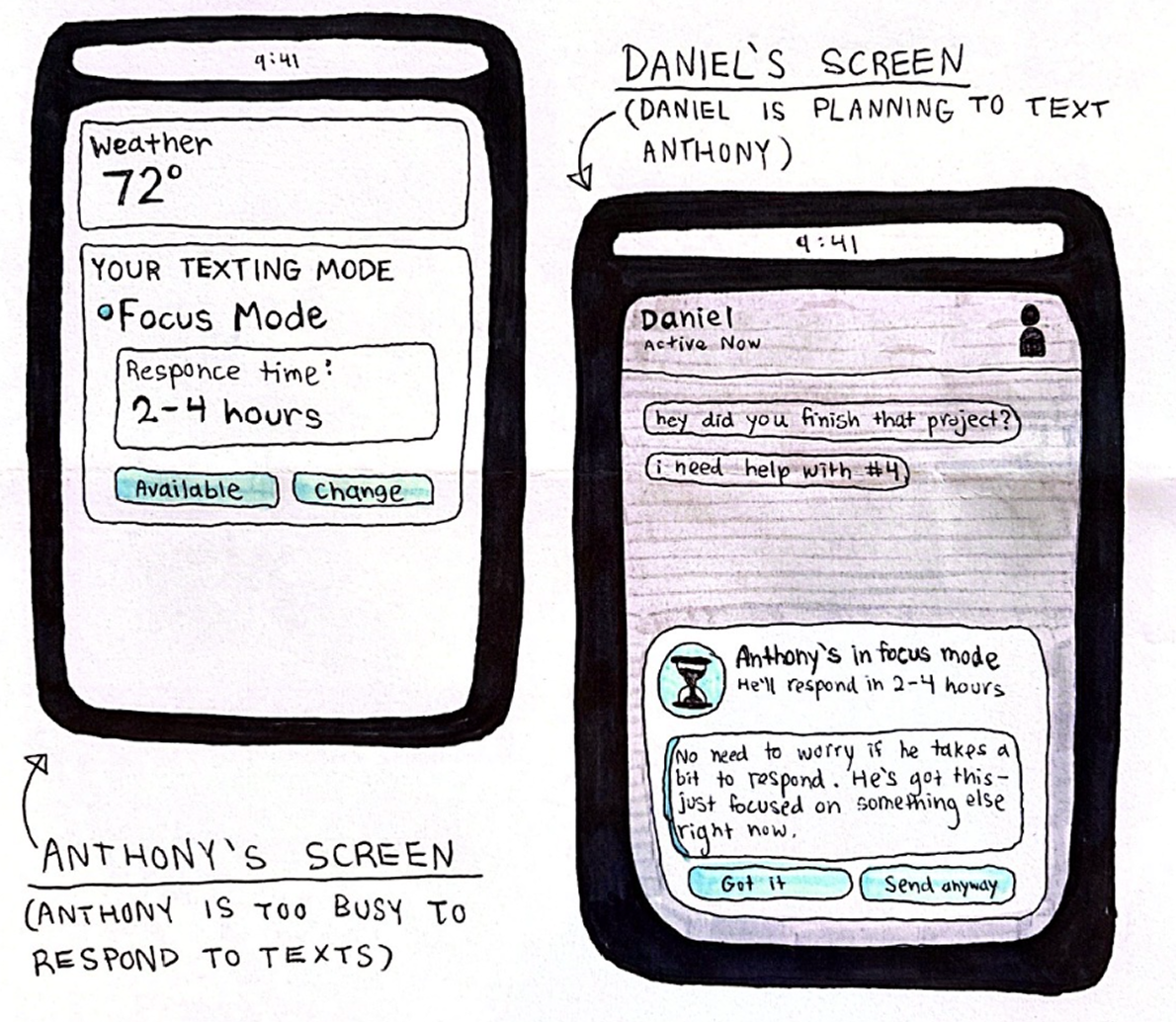
The solution working. Text-Assist in practice — what I was working toward all quarter.
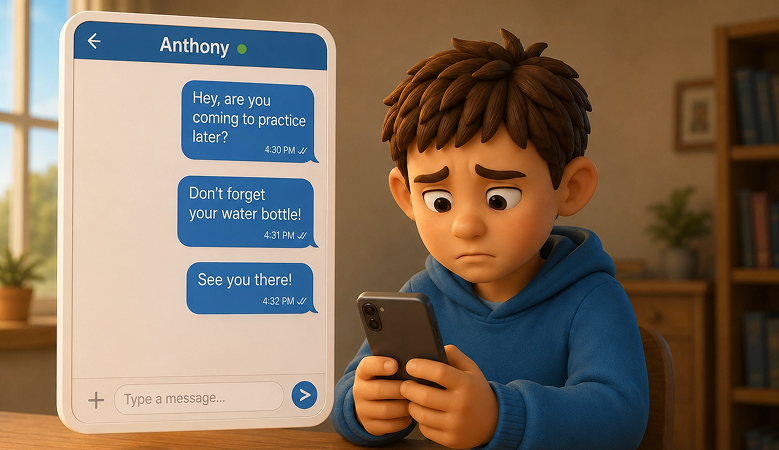
The schematic shows the complexity of the problem and how all of the components work together — cause-and-effect, combining, a broken chain.
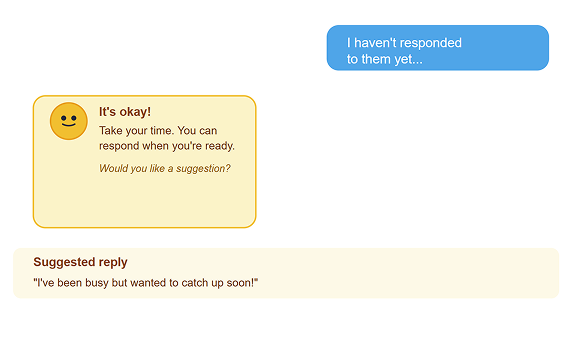
Exploring the visual language of the project — warmth, closeness, the feeling of being heard.
Daniel and Anthony — making the people real, not just the problem.