Before you enroll
Who this is for
How to stand out
The risk with these tools is funnel thinking: everyone converging on the same AI-shaped answer. This course focuses on the relationship you build with AI, so what you make is highlighted by the tools and not downplayed by them.
A method to call yours
Over ten weeks you build a methodology, not a toolbox. Tools change every few months. This class teaches you the way you decide what to keep, discard, or transform in what they give you.
AI is never the first nor last move
You are all designers, and we shouldn't delegate that. If you're looking for speed, this isn't it. If you want to sharpen your judgment until you can tell when the machine is wrong, it is.
Before you sign up
A note from your instructor
Highlighted projects from last cohort.
Have a look at what came out of the class in its first edition.

OVERHAND
A ring that helps create healthy distance between you and your phone. Our attention is being exploited; being conscious of our use helps us fight against that.
View project
IDENTITY CORE
A digital companion for the things we save and never open. Identity Core treats a personal archive as an extension of the self, and asks what it costs when you can't bring yourself to look at it.
View project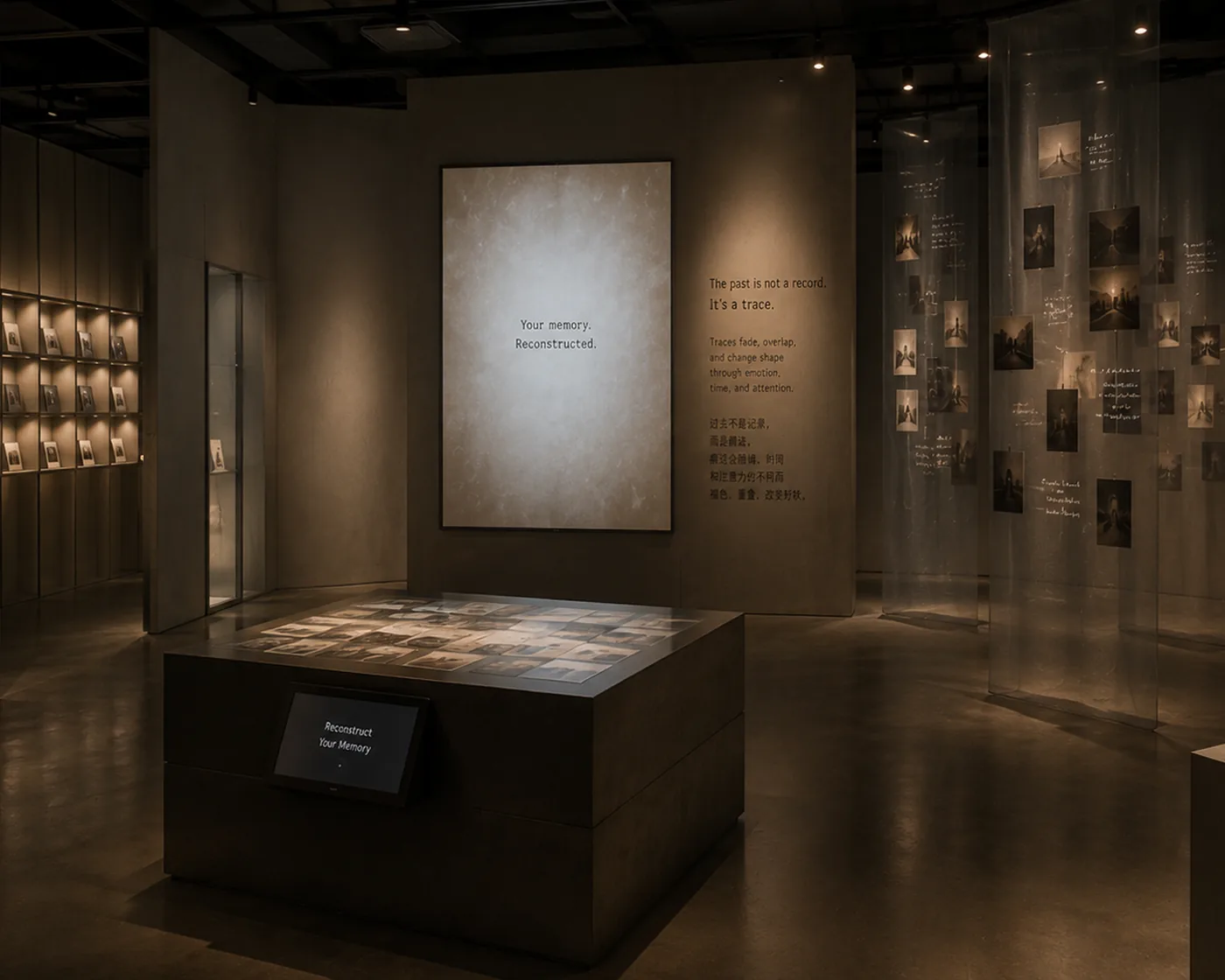
WHAT REMAINS
An interactive exhibition about memory and reconstruction. Three rooms, one memory: the factual record, the emotional register, the versions that conflict. The visitor chooses which one is theirs.
View projectIn their words
What I know now
I began by simply asking questions and waiting for the answer, but not thinking much on my own. Now I treat AI as a thinking partner […] I not only gain the answer but also gain the ability of more independent thinking. DES 191B student · Spring 2026
Across eight end-of-quarter survey responses, self-rated confidence using AI in creative practice rose from 2.3 to 4.1 out of 7.
Be prepared to experiment a lot. The course is less about learning tools and more about learning how to think and work with AI creatively.
Keep an open mind! I came in with very strong opinions about AI and while they have by no means reversed, the frustration has lessened.
I had never used AI before this course. I still start my projects through analog ideation, but after this class I know how to use AI later on in the process.
Questions
FAQ
Do I need prior AI experience?
No. The course starts from zero. Week 1 is about who's in the room and what AI actually is; the first real encounters with generative tools happen in Week 2. What matters more than experience is curiosity and a willingness to write down what you think before you generate anything.
Is this only for Design majors?
It's built primarily for Design students. If you're outside the major and want in, email me at jhmenezes@ucdavis.edu before you enroll so we can check eligibility and fit. Seats are capped, so ask early rather than after the quarter starts.
When does it meet, and how many seats are there?
Tuesdays and Thursdays, 9:00–11:50am, Fall quarter 2026. 24 seats. Sessions are studio-length because you'll be making in class, not just listening, and the cap keeps critique workable.
What's the workload actually like?
Studio-paced: something due most weeks. Weeks 1–4 build toward a midterm pitch, a public commitment to a direction. Weeks 5–9 are production across four deliverables: concept brief, brand board, a set of generated images, and a final video. Week 10 is the release and the closing reflection.
Which tools will we use?
Conversational models as thinking partners, image tools including Krea and Firefly, and Photoshop and Figma for production and documentation. The specific list shifts as tools do. The method is what carries: how you configure a tool, what you ask it, and how you judge what comes back.
Will I have to pay for tools?
You can complete the course on free tiers, and students have. Be aware of the tradeoff: one student last cohort noted their image quality was limited late in the quarter because they stayed on the free plan, and another said the paid subscriptions were worth it. Nothing is required, and no assignment is graded on output quality that only a paid tier can reach. Budget for it if you can; plan around it if you can't.
Am I allowed to use AI for everything?
No, and that's the point. You never start with AI and you never end with it. Concept briefs are written alone first, then stress-tested with your thinking partner. Sketches happen before any tool opens. Reflection at the end of each loop is yours alone. Everything in between is fair game.
How am I evaluated?
On process as much as output. Documentation is part of the work: the Week 10 deliverable is a narrative Figma page showing how you got there, not just what you ended with. Decisions you can account for count for more than a polished result you can't explain.
Will I leave with something for my portfolio?
Yes. The final project is built to stand on its own: a complete piece with documented process, plus a video. Work from the first cohort is published on this site, and strong projects from Fall 2026 will be too.
Ready to sign up?
24 seats, Fall 2026. Tuesdays & Thursdays, 9:00–11:50am.